A First-Timer’s Guide to the Moroccan Hammam Experience
The first time most travellers walk into a neighbourhood hammam in Marrakech, they stop dead in the doorway. Thick steam, the slap of water on tiled floors, a dozen women or men chatting on the ground with buckets beside them, and someone already gesturing at you to sit down. This Moroccan hammam guide is here so that moment feels exciting rather than awkward. We have sent hundreds of first-timers into hammams over the years, from tiny local bathhouses behind the bakery to marble palace spas, and the same questions come up every time.
In short: a hammam is a hot steam bath followed by a scrub with black soap and a rough glove, then a rinse, sometimes with clay. A public hammam costs roughly 10–25 MAD to enter and is a genuinely local experience; a riad or hotel spa costs roughly 250–1,500 MAD and gives you privacy, an attendant and a quiet relaxation room. Both are worth doing, for different reasons.
What a hammam actually is
For most Moroccans the hammam is not a treat but a weekly routine. Many older medina houses were built without proper bathrooms, so every neighbourhood traditionally had its own bathhouse, usually close to the mosque, the bread oven and the Qur’anic school. The same wood fire that heated the oven often heated the water. You will still see this arrangement walking through the Medina of Marrakesh or the Medina of Fez, both UNESCO World Heritage sites.
The hammam is also social, especially for women, who catch up on family news and prepare brides before weddings. Expect a few curious looks and probably some friendly help with your technique.
Public hammams vs luxury riad spas
This is the first decision to make, and there is no wrong answer. We usually tell our travellers to do a spa hammam first if they are nervous, then try a public one later in the trip once they know the steps.
Public (neighbourhood) hammams
A public hammam is a plain building, often with a modest painted sign and two separate doors marked for men (rijal) and women (nissa). Inside there is a changing area, then usually three rooms running from warm to very hot. There is no music, no candles and no fluffy robe. The floors are wet, the lighting is dim and the atmosphere is completely real.
- Cost: entry is roughly 10–25 MAD (about €1–2.50). A scrub from the resident attendant, called a kessala or tayeba, adds roughly 50–100 MAD.
- Privacy: very little. You wash alongside locals of the same sex.
- Etiquette: you bring your own supplies, keep your underwear on and follow local customs (more on this below).
The downsides are real. Cleanliness varies, and you need a little French or Darija, or a lot of pointing. Some hammams near tourist routes charge foreigners a few dirhams more; we would not argue.
Riad and hotel spas
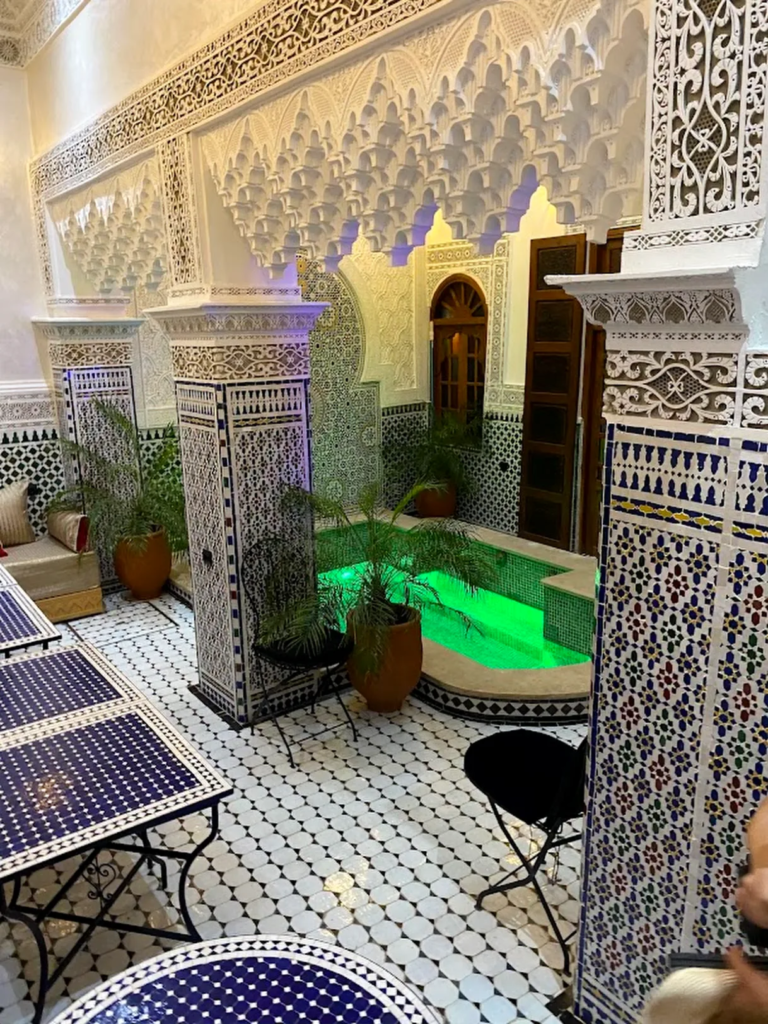
Most riads in Marrakech, Fes and Essaouira now have a small hammam, and the bigger hotels have full spas with marble steam rooms, plunge pools and massage cabins. Here the ritual is adapted for visitors: you are given disposable underwear, an attendant does everything for you, and afterwards you lie down with mint tea and a few almond pastries.
- Cost: roughly 250–500 MAD for a hammam and scrub in a mid-range day spa or riad, and roughly 700–1,500 MAD or more in a palace hotel, often bundled with a massage.
- Privacy: high. Many spas offer private or couples’ sessions, so mixed-sex couples and families can go together.
- Etiquette: relaxed. Staff explain everything and expect to be guided by your comfort.
The honest trade-off: a spa hammam is lovely, but it is a spa. You get the scrub and the steam without the neighbourhood life that makes the public hammam so memorable. If you are still choosing where to stay, our riad vs hotel guide covers which kind of property is more likely to have its own hammam.
Gender-separated hours
Public hammams are always segregated by sex. Larger ones have two separate sections running all day. Smaller ones share one set of rooms and alternate: a common pattern is women from late morning through the afternoon, and men early in the morning and in the evening. Times vary from hammam to hammam, so ask at your riad or check the hand-written sign by the door. Thursday evenings, Friday mornings before prayers and the days before Eid are the busiest. Mid-afternoon on a weekday is usually calmest.
Mixed bathing does not exist in public hammams. If you want to go as a couple, book a private session at a spa.
What to wear and basic etiquette
- Women usually strip to their underwear bottoms. Going topless is normal in the women’s section. Keep your bottoms on; full nudity is not the custom.
- Men wear shorts, swim shorts or underwear the whole time. Never undress fully, even in the changing room.
- Bring a dry set of underwear for afterwards, because the pair you wear will be soaked.
- Do not rinse your soap or splash water towards someone sitting next to you. Space on the floor is shared.
- Do not leave the hot tap running.
Non-Muslim visitors are generally welcome in public hammams, unlike most mosques. For what to wear on the street before and after, our what to wear in Morocco guide has practical advice.
The hammam process, step by step
Public or private, the ritual follows the same order. In a spa the attendant guides you; in a public hammam you do it yourself or hand yourself over to the kessala.
1. Undress and enter the steam
Pay at the desk, leave your clothes in the changing area (many have a cubby with an attendant; small bathhouses just have a bench) and walk through to the rooms. Spend a few minutes in the warm room, then move to the hot room. Fill your buckets with a mix of hot and cold water, sit on your mat and simply sweat for 10–15 minutes. Rinse yourself with water every few minutes. Do not rush this stage; the scrub only works on skin that has been softened by heat.
2. Savon noir (black soap)
Next comes savon beldi, the dark, jelly-like black soap made from olive oil and crushed olives. It smells earthy, sometimes with eucalyptus added. Spread a generous handful over your whole body, avoiding your eyes, and leave it for five to ten minutes while you keep steaming. It does not lather like ordinary soap. It is there to soften the skin, not to clean it.
3. Kessa glove exfoliation
Rinse off the soap, then comes the famous part. The kessa is a rough mitt, usually made of a coarse woven fabric, and it is rubbed firmly over every bit of your body in long strokes. Grey rolls of dead skin come away. Everyone is horrified the first time, and everyone secretly enjoys it.
If you pay a kessala, she or he will scrub you with real force, folding you into positions you would not choose yourself. Say shwiya (gently) if it is too much. We have watched plenty of travellers come out of their first public scrub in Fes looking slightly shell-shocked, and then ask the next morning when they can go again.
4. Ghassoul clay and final rinse
After the scrub, many people apply ghassoul (also written rhassoul), a brownish clay mined in the Middle Atlas and mixed with water, sometimes with rose water or herbs. It goes on hair and body as a mask, is left for a few minutes and then rinsed off. Your skin feels noticeably silky. Some women follow with henna for the hair or a little argan oil on the body.
Finish with a cooler rinse, move back through the warm room to let your body temperature settle, and dress slowly. In a spa you will be wrapped in a robe and given tea; in a public hammam you will often see people sitting in the changing room for a while with a bottle of water before heading back out.
What to Bring to a Public Hammam
- Savon noir (black soap), a small pot or bag is enough
- A kessa exfoliating glove
- Ghassoul clay (optional, but recommended)
- Shampoo and a comb
- A towel and a spare set of dry underwear
- Flip-flops for the wet floor
- A small plastic mat or bag to sit on
- Small change in dirhams for entry, the scrub and a tip
- A bottle of water
Most hammams sell basic supplies at the counter, and every corner shop near a hammam sells a ready-made kit. Leave jewellery and valuables at your riad.
Approximate hammam prices in Morocco (2026)
Prices below are approximate and vary by city, season and how close you are to the main tourist streets. Marrakech is the most expensive; smaller towns are cheaper. Euro amounts assume roughly 10–11 MAD to €1.
| Item | Approximate price (MAD) | Approximate (€) |
|---|---|---|
| Public hammam entry | 10–25 | €1–2.50 |
| Scrub by public hammam attendant | 50–100 | €5–10 |
| Supplies kit (black soap, kessa, ghassoul) | 30–70 | €3–7 |
| Tip for attendant | 10–30 | €1–3 |
| Riad hammam and scrub (about 45 min) | 250–450 | €25–45 |
| Mid-range day spa hammam and scrub | 300–500 | €30–50 |
| Hammam with massage package (mid-range) | 500–900 | €50–90 |
| Palace hotel spa hammam ritual | 800–1,500+ | €75–140+ |
For context on how a hammam fits into a daily budget, see our guide to how expensive Morocco is.
Practical tips from our team
- Timing. Avoid going straight after a big tagine lunch or on an empty stomach. Late afternoon, before dinner, is ideal.
- Skin. Do not have a hammam the same day as shaving, waxing or getting sunburnt. Leave a day or two. The kessa on freshly shaved legs is not pleasant.
- Health. If you are pregnant, have heart or blood pressure problems, or feel faint in heat, choose a spa where you can control the temperature and tell the attendant. Drink water before and after.
- After the desert. A hammam is the best possible cure for two days of Sahara sand. Many of our travellers book one in Marrakech the evening they return from a 3-day Marrakech to Merzouga desert tour.
- Booking. Spas get busy, especially at weekends and in spring and autumn. Book a day ahead. Public hammams need no booking.
- Women travelling alone. The women’s section of a public hammam is one of the most relaxed, welcoming places in Morocco for a solo female traveller. Local women often help with the scrub or show you the order of things.
- Photos. Never take photos inside a hammam, not even of the empty rooms, without explicit permission.
- Souvenirs. Black soap and ghassoul make cheap, light gifts. Buy them from medina herbalists rather than tourist boutiques.
For more on Moroccan wellness and food culture, the official tourism portal, Visit Morocco, is a good starting point.
Where to try your first hammam
In Marrakech, every derb in the medina has its own neighbourhood hammam, and the areas around Mouassine, Bab Doukkala and the Kasbah have several that are used to foreign visitors. The Gueliz and Hivernage districts have most of the bigger day spas. If you want someone to guide you through the first visit, it can be added to most of our Marrakech tours.
Fes is arguably even better for a traditional experience. Many of its bathhouses are centuries old and still heated by wood fires, and the medina feels less geared to tourism. It pairs well with a day of exploring with one of our Fes tours. Smaller towns such as Chefchaouen, Essaouira and Meknes also have friendly local hammams with lower prices.
If you want a hammam built into your trip at a palace riad or a high-end spa, our luxury Morocco tours include spa time as standard, and we can add it to any tailor-made trip.
Frequently asked questions
Do you get naked in a Moroccan hammam?
Not fully. Women usually keep their underwear bottoms on and are often topless in the women’s section. Men keep shorts or underwear on at all times. Spas give you disposable underwear.
Can tourists go to a public hammam in Morocco?
Yes. Non-Muslim visitors are generally welcome in public hammams. Go during the correct hours for your sex, bring your own supplies or buy them at the counter, and follow what the locals do.
How much does a hammam cost in Marrakech?
Roughly 10–25 MAD for public hammam entry plus 50–100 MAD for a scrub, or roughly 250–500 MAD for a hammam and scrub in a riad or day spa. Palace hotel spas charge roughly 800–1,500 MAD or more. All prices are approximate.
How long does a hammam take?
Allow 45 minutes to an hour for a spa hammam and scrub, and up to 90 minutes in a public hammam, where nobody rushes. Add time to rest and drink water afterwards.
Can couples go to a hammam together?
Not in a public hammam, which is always separated by sex. Many riads and spas offer private or couples’ hammam sessions.
How often should you do a hammam scrub?
Many Moroccans go weekly, but a full kessa scrub once every week or two is plenty for most visitors. On a one or two-week trip, one or two hammams is ideal.
A hammam is one of the simplest, cheapest and most memorable things you can do in Morocco, and it is the perfect reset after long days in the souks or the dunes. If you would like us to build one into your itinerary, from a neighbourhood bathhouse with a local guide to a full spa afternoon, get in touch with our Marrakech team and we will plan it with you.