Driving in Morocco: Essential Tips for Renting a Car and Road Trips
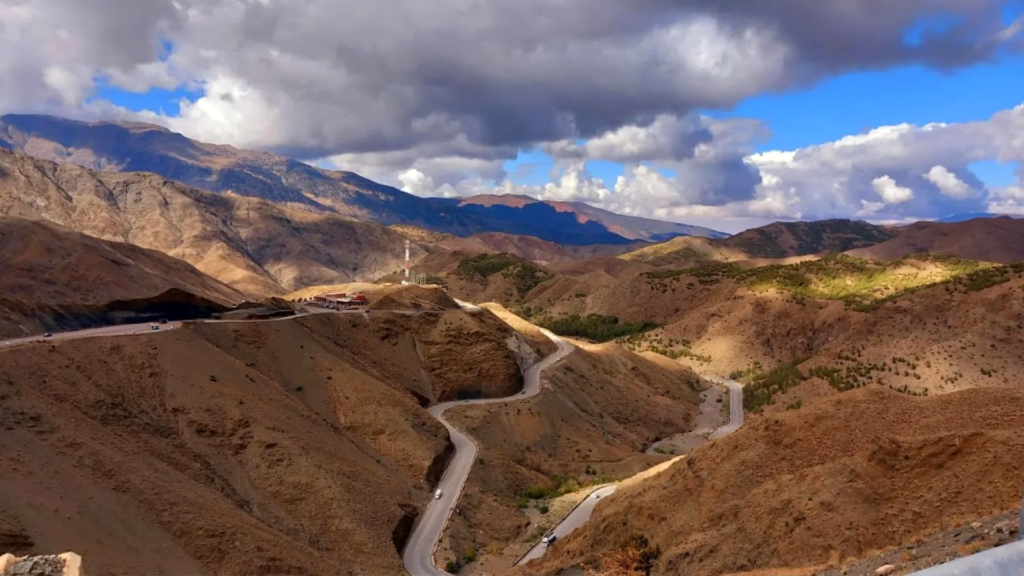
Most of our travellers spend their first ten minutes in a Marrakech hire car at a roundabout, wondering whether anyone is in charge. Then they get out onto the N9, the city falls away behind them, the High Atlas rises ahead, and they understand why driving in Morocco is worth the effort.
Our team has driven these roads for years, in every season. Here is what you actually need to know.
Quick answer
Yes, driving in Morocco is perfectly doable for a confident driver. Motorways are excellent, main roads are generally good, and mountain passes are slow but manageable in daylight. The hard parts are city traffic, unlit rural roads at night and finding parking near the old towns. Bring your licence, consider an International Driving Permit, keep your papers in the glovebox and never drive after dark in the mountains if you can avoid it.
Requirements for renting a car in Morocco
Driver’s licence and International Driving Permit
Visitors can drive on a valid licence from their home country for up to a year.
We still recommend an International Driving Permit. It costs little at home, some rental agencies ask for one, and it removes any argument at a roadside stop where the officer may read French or Arabic but not Dutch or German. Most companies want drivers aged at least 21 (sometimes 23) with a licence held for one to two years; under-25s often pay a young driver surcharge.
Insurance options
Third-party liability insurance is compulsory and included in every rental. The real question is the excess. Standard collision damage waiver (CDW) usually leaves you liable for roughly 5,000–15,000 MAD (about €450–1,400) if the car is damaged.
Most agencies sell a “super CDW” or full cover that cuts the excess to zero or close to it, typically for an extra 80–200 MAD a day (approximate). On Moroccan roads, with gravel shoulders, kerb-hugging taxis and narrow medina lanes, we think it is money well spent. Tyres, windscreen and off-road damage are often excluded, so read the small print.
Deposit and pick-up checks
Expect a deposit blocked on a credit card, usually 5,000–15,000 MAD depending on the car and your insurance level.
At pick-up, walk round the car with the agent and photograph every scratch, the tyres, the spare and the fuel gauge. Make sure the glovebox holds the registration document (carte grise), the insurance certificate and the rental contract, because the police will ask for them. You can compare options and book through our rent a car in Morocco page, with collection at the main airports and city offices.
Driving conditions: what the roads are really like
Autoroutes and tolls
Morocco’s motorway network, run by Autoroutes du Maroc, is a pleasant surprise: smooth, well signed in Arabic and French, and often nearly empty outside the Casablanca–Rabat corridor.
Tolls are paid at booths in cash or by card at most stations. As a rough guide, Casablanca to Marrakech costs around 80–100 MAD for a car, and Rabat to Fes somewhat less (approximate, prices change). The speed limit is 120 km/h.
National roads and High Atlas passes
Off the motorway, the limit drops to 100 km/h on open roads and 60 km/h (sometimes 40) in towns. National roads are mostly tarmacked and decent, but you share them with lorries, grand taxis, mopeds, donkey carts and pedestrians walking on the verge.
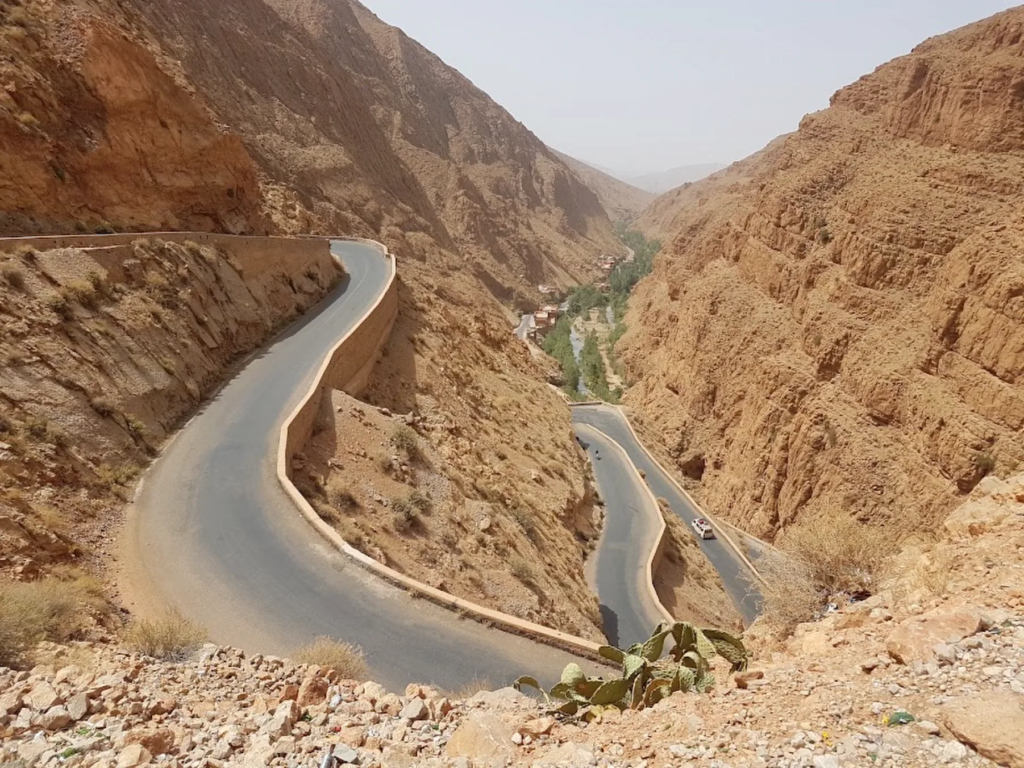
The famous one is the Tizi n’Tichka on the N9 between Marrakech and Ouarzazate, climbing to 2,260 m. The road has been widened and resurfaced in recent years, but it is still a long series of hairpins with lorries crawling uphill. Allow around four hours for the roughly 200 km, without stops. Snow can close it for a few hours or a day between December and February; a sign at the foot of the pass near Toufliht shows whether the col is open.
The Tizi n’Test (R203, about 2,100 m) between Marrakech and Taroudant is narrower, steeper and far more dramatic, with sheer drops and few barriers. It was badly damaged in the September 2023 Al Haouz earthquake, and reconstruction has continued in stages since. Check current conditions with your rental company or a local before committing, and only tackle it in dry weather and full daylight.
Our mountain driving rules
- Use a low gear on long descents rather than riding the brakes.
- Sound your horn lightly before blind bends on narrow roads; locals do.
- Do not overtake lorries on the Tichka unless you can see the whole straight.
Night driving, animals and roundabouts
We tell every self-driving traveller the same thing: avoid driving at night outside cities. Rural roads are rarely lit, sheep and goats wander across, cyclists and carts often have no lights, and oncoming lorries tend to keep their full beams on.
Roundabouts are the other learning curve. The traditional rule of priority to the right still governs many junctions, which means cars entering a roundabout may expect you to give way to them, unless signs say otherwise. In practice, drive slowly, watch what the cars around you do and leave space.
Two other non-negotiables: seatbelts are compulsory front and back, and drink-driving is treated very seriously, with a near-zero limit.
Police checkpoints and speed traps
You will meet the police, probably several times a day. In towns it is the Sûreté Nationale; on rural roads it is the Gendarmerie Royale in their grey-blue uniforms. Checkpoints sit at the entrance and exit of most towns, marked by a red-and-white sign reading “Halte Police” or “Stop”, often with a spike strip laid partly across the lane.
How to handle a checkpoint
Slow right down as you approach and come to a full stop at the line, even if the officer seems to be ignoring you. Rolling through a stop sign at a checkpoint is itself an offence. Usually you will be waved on. If you are stopped, wind down the window, greet the officer (“Bonjour” or “Salam alaykum” works wonders) and hand over your licence, passport and the car papers when asked.
Speed traps and on-the-spot fines
Radar guns are common, especially just past the 60 km/h sign at the entrance to a village, where the limit can drop abruptly from 100. Watch for oncoming drivers flashing their headlights; it usually means a radar ahead.
Fines are set by category, commonly 300, 500 or 700 MAD (roughly €28–65) depending on the offence. They are normally paid on the spot, and you should receive an official printed or handwritten receipt. Ask for it politely. Never offer money informally; it can turn a minor fine into a serious problem. If a fine is recorded against the car rather than paid, the rental company will usually charge it to your card with an admin fee.
For broader safety context, the UK Foreign Office advice for Morocco and the US State Department country page both have up-to-date sections on road travel.
Parking near the medinas
You cannot drive into most old towns. Fes el-Bali is entirely car-free, and in Marrakech the medina lanes are a tangle of mopeds and handcarts that you really do not want to attempt in a hire car. The trick is to park outside the walls and walk or take a petit taxi in.
Guarded car parks
Every big medina has guarded lots near the main gates. In Marrakech there are car parks around the Koutoubia and near Bab Doukkala; in Fes, the lots by Bab Boujloud and Bab Ftouh are the usual choice; in Chefchaouen, park on the edge of town near Bab el Ain. Expect roughly 20–50 MAD for an overnight stay (approximate). If you are staying in a riad, ask the owner where their guests park; many have an arrangement with a nearby guarded lot and will send someone to meet you.
The gardien de voiture
Almost every street with parking spaces has a gardien de voiture, usually a man in a fluorescent vest who watches cars for a tip. It is an informal but recognised job. Pay when you leave, not when you arrive: around 5–10 MAD for a short daytime stop and 20–30 MAD overnight is typical.
Parking tips from our drivers
- Never leave bags, phones or anything visible in the car.
- Do not accept “help” from strangers who offer to guide you to your riad by car; they expect a fee and often lead you to a shop.
Fuel: what to expect at the pump
Petrol stations are plentiful on main routes, run by brands such as Afriquia, Shell, TotalEnergies, Petrom and Winxo. An attendant fills the tank for you; a tip of 2–5 MAD is appreciated, more if they also clean the windscreen. Diesel is gasoil and unleaded is sans plomb. Most rental cars run on diesel, so check the sticker inside the fuel flap.
Prices float with the market. In 2026 expect very roughly 11–13 MAD a litre for diesel and 13–15 MAD for petrol (approximate). Large stations take cards, but in the south carry cash. Between Ouarzazate and Zagora, or on the back roads around Merzouga and Tata, stations can be 100 km apart, so we always top up when the tank drops below half.
Road-trip route ideas
| Route | Distance (approx.) | Days we suggest | Highlights |
|---|---|---|---|
| Marrakech – Ouarzazate – Dades – Merzouga – Marrakech | 1,200 km loop | 5–7 | Tizi n’Tichka, Ait Ben Haddou, Todra Gorge, Erg Chebbi dunes |
| Fes – Ifrane – Merzouga | 470 km | 2–3 | Middle Atlas cedars, Ziz Valley, desert |
| Tangier – Chefchaouen – Fes | about 400 km | 3–4 | Rif mountains, blue town, Volubilis detour |
| Marrakech – Essaouira – Agadir | about 450 km | 3–4 | Argan country, Atlantic coast, surf towns |
The classic south loop
This is the road trip most people imagine. Day one takes you over the Tichka to Ait Ben Haddou, the fortified ksar near Ouarzazate. From there you follow the Road of a Thousand Kasbahs through the Dades Valley to Todra Gorge, then cut across to Merzouga. Marrakech to Merzouga direct is around 560 km and 9–10 hours of driving, which is why we always split it.
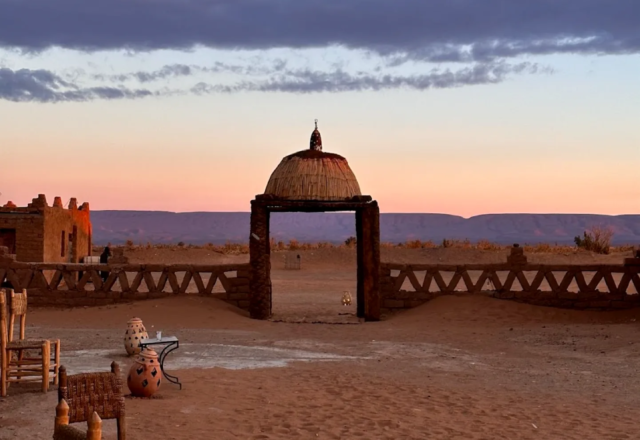
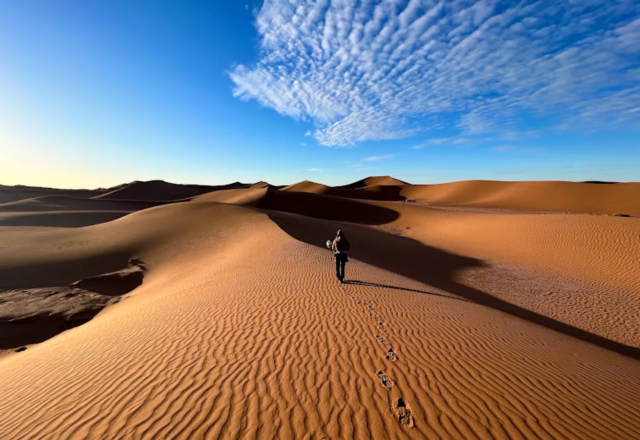
One honest note: the final stretch into the Erg Chebbi camps is sand, not tarmac. Leave your hire car at your hotel or the camp’s car park and let the camp collect you. Our Morocco desert tours can arrange the camel ride and night in the dunes even if you drive yourself there.
North and coast
The Fes to Merzouga drive, about 470 km and 7–8 hours, crosses the Middle Atlas at Ifrane and Azrou, where Barbary macaques sit by the road in the cedar forest. On the coast, the R207 and N1 between Essaouira and Agadir pass goats climbing argan trees and long empty beaches. For timing, our guide to the best time to visit Morocco explains when mountain snow and summer heat affect the roads, and our 7-day Morocco itinerary works well as a self-drive skeleton.
Not keen to drive? Consider a car with a driver
Plenty of travellers try a day in Marrakech traffic and decide they would rather look at the view than the road. A car with driver costs more than a self-drive rental, but you skip the deposit, the checkpoints, the parking and the night driving question entirely, and you gain someone who knows which café on the Tichka does the best msemen. For the trains and buses between the northern cities, see our guide to getting around Morocco.
If you would like the freedom without the logistics, our 3-day Marrakech to Merzouga desert tour follows the same road with an experienced local driver.
Frequently asked questions
Is it safe to drive in Morocco as a tourist?
For a confident, alert driver, yes. Motorways and main roads are generally good. The main risks are unpredictable city traffic, unlit rural roads at night and animals on the road, so drive in daylight and keep your speed down in villages.
Do I need an International Driving Permit to drive in Morocco?
A valid home licence is usually accepted for tourists, but an International Driving Permit is recommended. Some rental companies ask for one, and it makes police checks smoother.
Which side of the road do they drive on in Morocco?
Morocco drives on the right, with left-hand-drive cars. Road signs are in Arabic and French, and distances are in kilometres.
How much does it cost to rent a car in Morocco?
A small economy car such as a Dacia Logan or Renault Clio typically costs around 250–450 MAD (€23–42) a day in low season and more in peak months, plus extra for full insurance. Prices are approximate and vary by season and pick-up point.
Can I drive a normal rental car to the Sahara?
Yes, the tarmac road reaches Merzouga and the edge of Erg Chebbi. You do not need a 4×4 for the main route, but do not take a standard car onto sand or rough pistes, as insurance usually excludes that damage.
What should I do if I am stopped by the police?
Stop fully, stay calm and polite, and show your licence, passport, rental contract and car papers. If you are fined, pay the official amount and ask for a receipt.
Planning a road trip and not sure whether to self-drive, hire a driver or mix the two? Tell us your dates and route and our Marrakech team will put together a tailor-made trip around it, or simply get in touch with us for honest advice on the roads.