Merzouga vs. Agafay Desert: Which Experience Should You Choose?
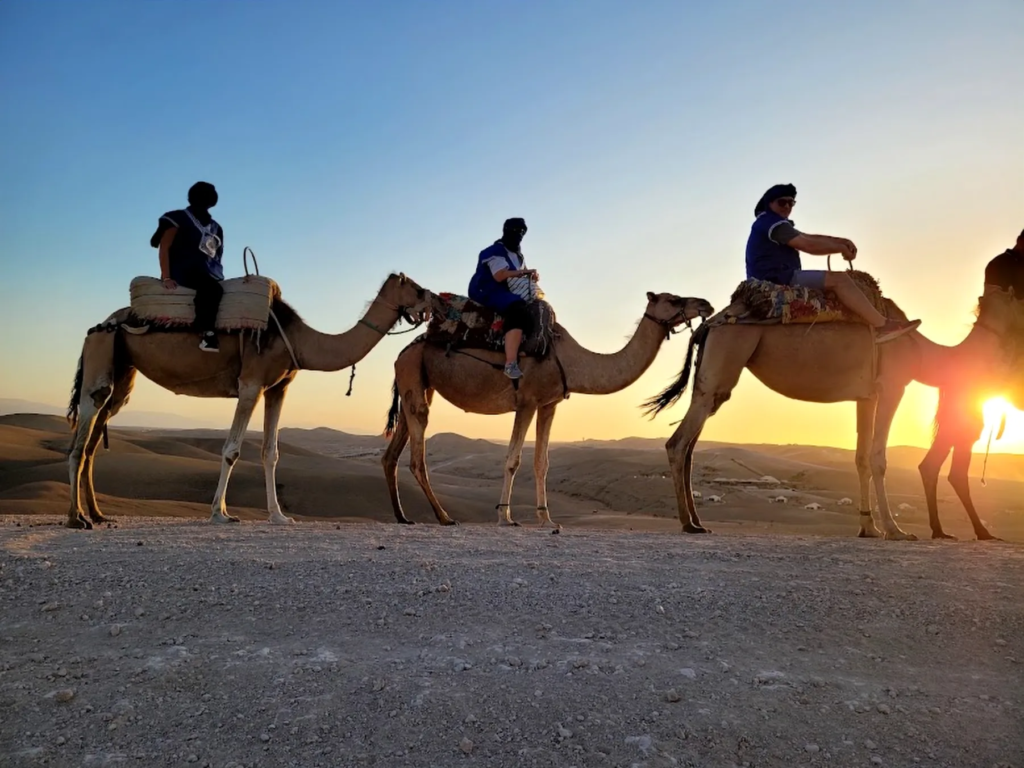
Almost every week someone writes to our office in Marrakech with the same question: is it worth driving all the way to the Sahara, or will the desert just outside the city do? The Merzouga vs Agafay desert debate comes down to time, expectations and what you picture when you hear the word “desert”. One is a sea of apricot-coloured sand on the edge of Algeria. The other is a bare, rolling stone plateau you can reach before your mint tea goes cold.
We have taken travellers to both hundreds of times, and neither is the wrong choice. They are simply very different experiences, and it pays to know which one you are booking.
In short
Choose Merzouga (Erg Chebbi) if you want real Saharan sand dunes, a camel trek at sunset and a night under a huge sky, and you have at least three days. Choose Agafay if you have one evening or one day spare in Marrakech and want desert-style scenery, good food and Atlas views without the long drive.
Merzouga and Erg Chebbi: the classic Sahara
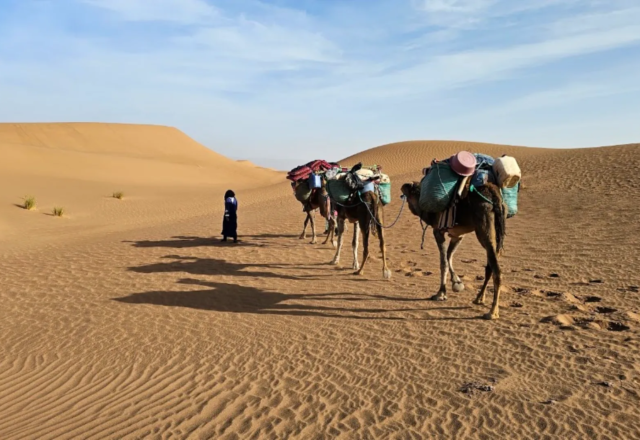
Erg Chebbi is the dune field that sits behind the village of Merzouga in south-eastern Morocco. The dunes stretch roughly 22 km north to south and the tallest rise to around 150 m. At dawn the sand is pale gold; by late afternoon it turns copper, then a deep rust red. It is the landscape most people have in their heads when they book a trip to Morocco.
Getting there from Marrakech
This is the catch. Marrakech to Merzouga is about 560 km and takes 9 to 10 hours of driving, not counting stops. The road climbs over the High Atlas via the Tizi n’Tichka pass at 2,260 m, drops to Ouarzazate, then follows the valley of the Dades and the Todra Gorge before the long straight run past Erfoud. Coming from Fes it is shorter, around 470 km and 7 to 8 hours through the Middle Atlas and the Ziz Valley.
That is why we never recommend Merzouga as a there-and-back in two days. Our 3-day Marrakech to Merzouga desert tour splits the journey with a night in the Dades Valley and stops at the fortified village of Ait-Ben-Haddou, so the drive becomes part of the trip rather than a punishment.
Camps and glamping
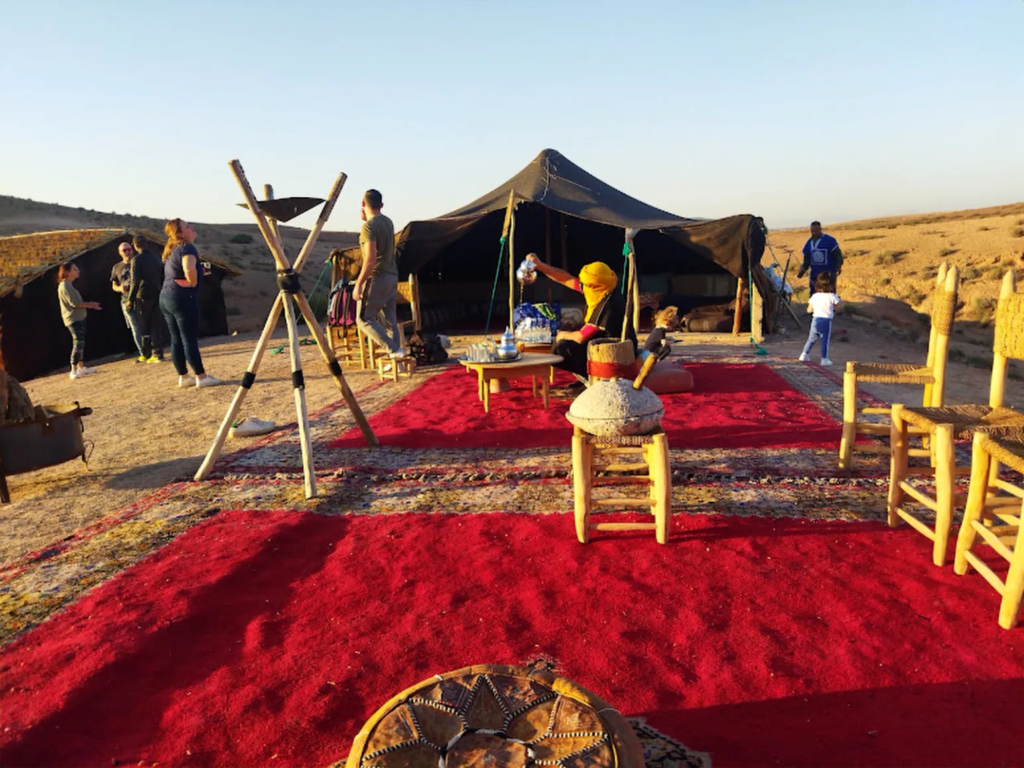
Camps in Erg Chebbi range from simple Berber camps with shared toilets and wool blankets to luxury tents with private bathrooms, hot showers and proper beds. The standard camps are clean and atmospheric; the glamping camps add comfort and a quieter setting, often further into the dunes. Dinner is usually harira or salad, a chicken or vegetable tagine and fruit, followed by drumming around the fire.
As a rough guide, a night in a standard camp including dinner, breakfast and camel trek costs approximately 400–700 MAD (€40–65) per person, while luxury camps run approximately 1,200–3,000 MAD (€110–280) per person. Prices vary with season and how far into the dunes the camp sits.
Camel treks and other activities
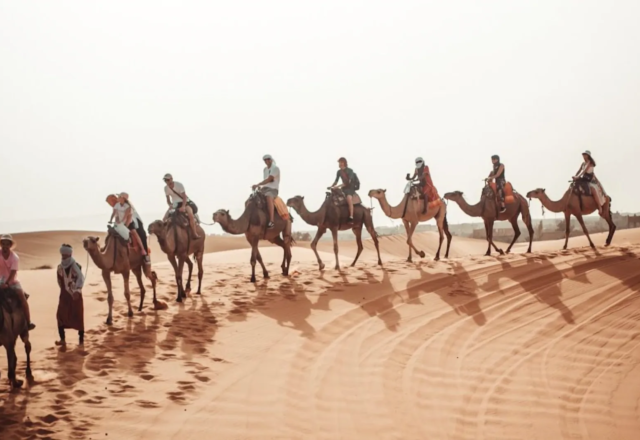
The ride out to camp is the moment most people remember. You set off from the edge of Merzouga about an hour and a half before sunset, the camels walking in single file while the shadows of the dunes lengthen. Expect 60 to 90 minutes in the saddle. It is gentle, but your thighs will notice the next morning. For longer routes with nights in nomad tents, see our camel trekking trips.
Beyond camels, Merzouga offers sandboarding, quad bikes and dune buggies, visits to Gnaoua musicians in the village of Khamlia, and a trip to the seasonal lake at Dayet Srji where flamingos sometimes appear after wet winters. Our page on Merzouga activities covers the options and prices.
One honest downside: the light pollution is minimal, but the camps are not empty. In peak months (October, late December, March and April) you will see other camps and other camel caravans. Pick a camp deeper in the dunes if solitude matters to you.
Agafay Desert: the stone desert on Marrakech’s doorstep
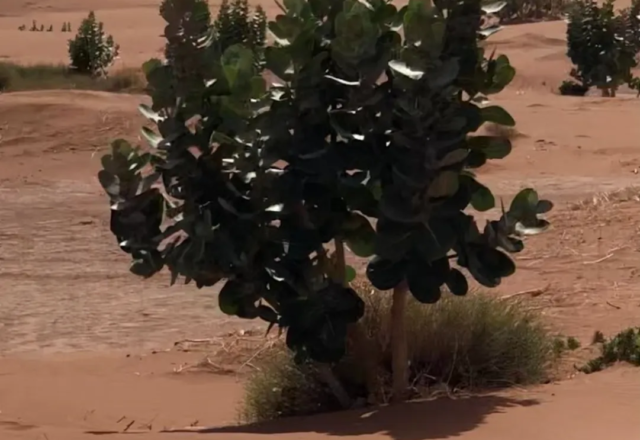
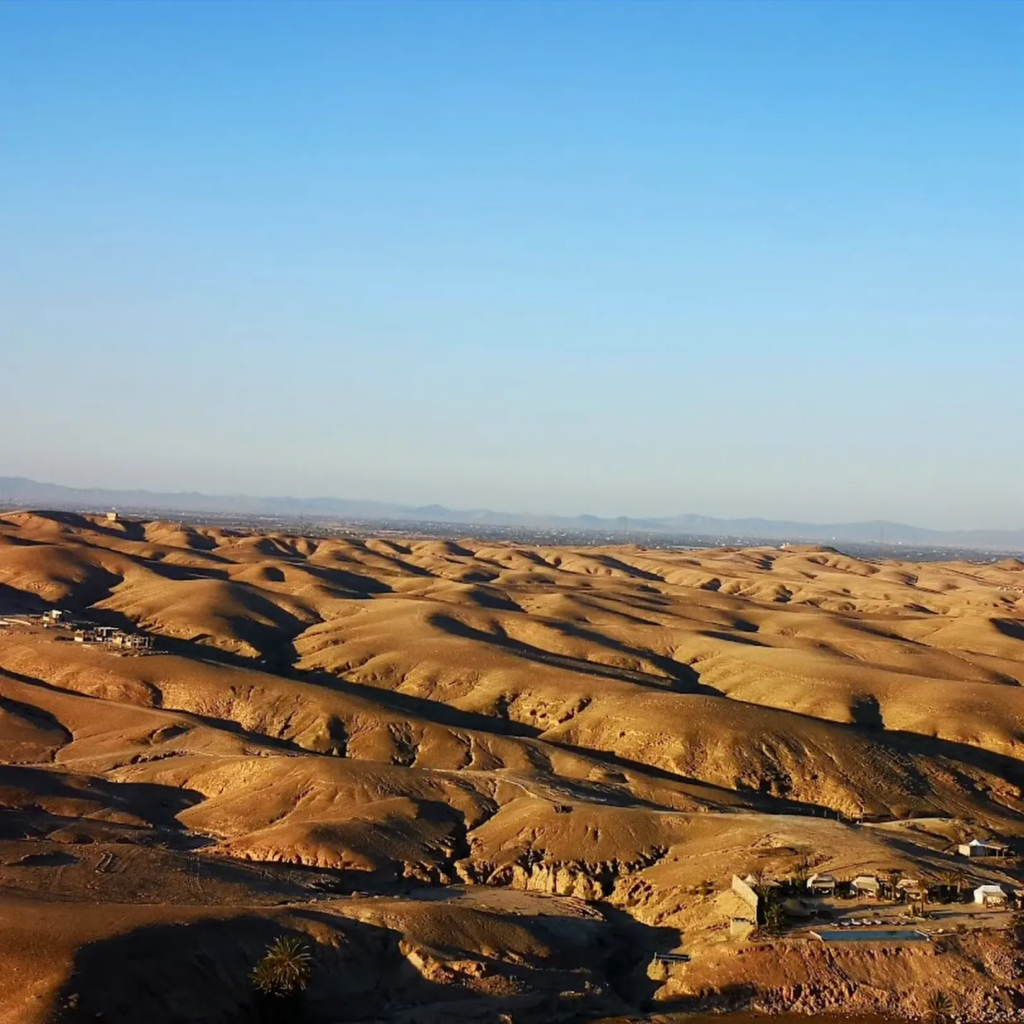
Agafay is not a sand desert. It is a hamada, a dry, rocky plateau of beige and ochre hills, scrub and dust, about 40 km south-west of Marrakech. There are no towering dunes here and no one who knows the place pretends otherwise. What it does have is space, silence after the noise of the medina, and a view that on a clear winter day takes in the snow-capped High Atlas, with Jbel Toubkal on the horizon.
Getting there
The drive takes about 45 minutes, heading out on the road towards Amizmiz and past the Lalla Takerkoust reservoir. Most camps arrange transfers from your riad or hotel. Many travellers leave Marrakech at 4 pm, watch the sunset from the camp terrace, eat dinner and are back in the city before midnight.
Luxury day and night escapes
Agafay has grown fast over the past decade, and most of its camps lean towards the upmarket end: canvas suites with en-suite bathrooms, swimming pools, lounge areas with cushions and lanterns, and kitchens that do a good job of Moroccan and Mediterranean dishes. Some camps run solar power and keep things low-key; others have DJ nights and large group dinners.
Typical prices, all approximate:
- Day pass with lunch and pool access: 400–800 MAD (€40–75) per person
- Sunset dinner with transfer and live music: 450–900 MAD (€45–85) per person
- Overnight in a luxury tent with dinner and breakfast: 1,500–5,000 MAD (€140–460) per tent
Quad and camel rides
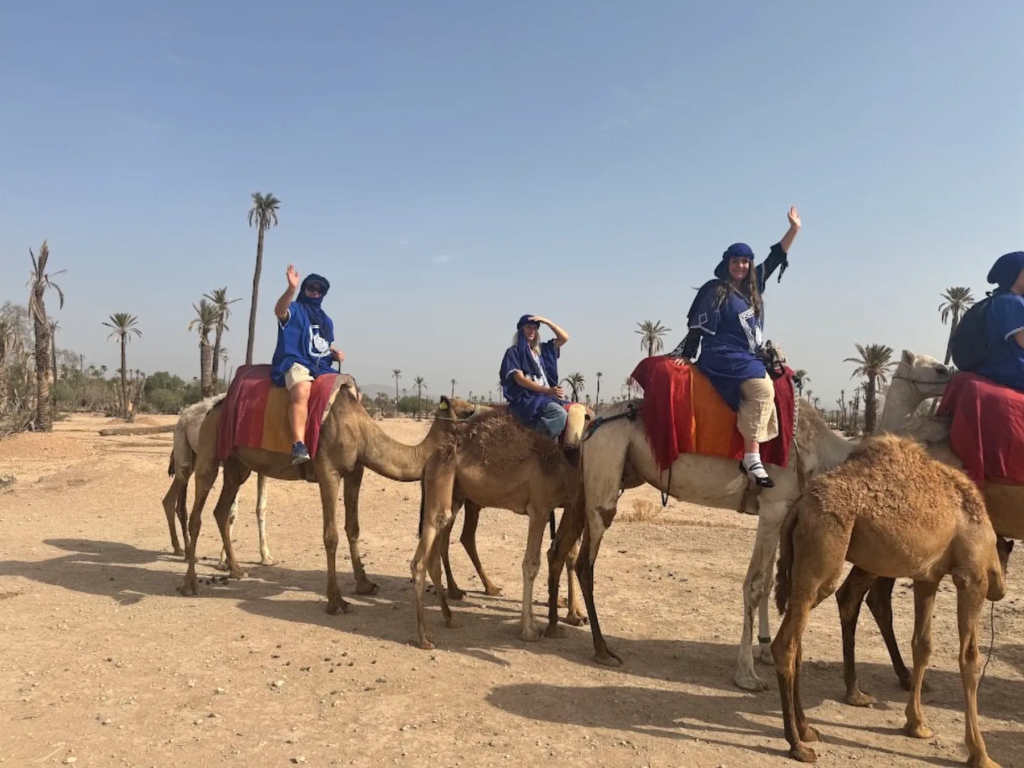
Quad biking is the main activity in Agafay, and the stony tracks suit it well. A one- or two-hour ride costs approximately 350–600 MAD (€35–55). Camel rides are offered too, usually 30 minutes to an hour around the camp. We tell our travellers to treat the Agafay camel ride as a pleasant photo stop rather than a trek; walking a camel across gravel hills is not the same as swaying over sand dunes. Our Marrakech tours include Agafay packages that combine quads, a camel ride and dinner.
Comparison table: Merzouga vs Agafay at a glance
| Feature | Merzouga (Erg Chebbi) | Agafay Desert |
|---|---|---|
| Landscape | Golden sand dunes up to around 150 m high | Rocky, rolling stone desert (hamada) |
| Distance from Marrakech | About 560 km, 9–10 hours by road | About 40 km, around 45 minutes |
| Minimum time needed | 3 days from Marrakech (2 nights) | Half a day or one evening |
| Accommodation | Berber camps to luxury glamping in the dunes | Mostly upmarket camps and eco-lodges |
| Camel experience | 60–90 minute trek over the dunes to camp | Short ride of 30–60 minutes |
| Other activities | Sandboarding, quads, buggies, Khamlia music, nomad visits | Quad biking, pool, horse riding, sunset dinners |
| Views | Endless dunes, sunrise over the Sahara, dark night skies | High Atlas mountains, Lalla Takerkoust lake |
| Approx. cost | Shared 3-day tour from roughly 1,000–1,600 MAD per person; private tours more | Evening packages from roughly 450 MAD per person |
| Best for | First-time visitors wanting “the real Sahara” | Short stays, families, honeymooners, travellers who dislike long drives |
Who should choose which?
Choose Merzouga if…
- You have at least three days to spare and want the iconic sand-dune Sahara.
- The road trip appeals: kasbahs, gorges, palm groves and mountain passes along the way.
- You want a proper camel trek and a sunrise over the dunes.
- You are continuing to Fes, since the desert sits neatly between the two cities.
Last spring a couple from Leeds told us at the end of their trip that the second day, driving through the Todra Gorge, was as memorable as the dunes themselves. That is common. Merzouga is a journey, not just a destination. Browse our Morocco desert tours for routes from Marrakech and Fes, or see how it fits into a 7-day Morocco itinerary.
Choose Agafay if…
- You only have a long weekend in Marrakech.
- You are travelling with small children, older relatives, or anyone who struggles with long car journeys.
- You care more about a beautiful dinner setting and a pool than about authentic dunes.
- You want a romantic night away from the medina without losing a whole day to transport.
We once had a family with a three-year-old who had planned the full Sahara loop and quietly realised on day one that 20 hours in a car was not going to work. We switched them to a night in Agafay. They loved it, and nobody had a meltdown on the Tichka pass.
Can you do both?
Yes, and it is not as odd as it sounds. Some travellers spend a sunset evening in Agafay at the start of their stay, then head to Merzouga later. The two feel so different that one does not spoil the other.
When to go
Both deserts are at their best from October to April. Merzouga in July and August regularly passes 45°C in the afternoon, and while camps adjust timings, it is hard going. Winter nights in the Sahara can drop close to freezing, so bring a warm layer even if the days are sunny. Agafay is hot in summer too, though an evening visit with a pool is manageable. Our guide to the best time to visit Morocco breaks it down month by month, and you can check the official Visit Morocco portal for regional events.
Packing tips from our drivers
- A scarf or cheche to cover your face from wind-blown sand (camps and Merzouga shops sell them for around 50–100 MAD).
- A warm fleece for desert nights, even in April.
- Sunglasses and high-factor sun cream.
- A small overnight bag; big suitcases stay in the vehicle in Merzouga.
- Cash in dirhams for tips and extras, as card machines are unreliable in camps.
For what to wear in the desert and in towns, see our guide to what to wear in Morocco. Before travel, check the latest UK government travel advice for Morocco or your own country’s equivalent.
Frequently asked questions
Is Agafay a real desert?
Yes, but a stony one. Agafay is a dry rocky plateau with very little vegetation, not a sand desert. If you are expecting Saharan dunes you will be disappointed; if you want desert space and mountain views close to Marrakech, it delivers.
Can I visit Merzouga as a day trip from Marrakech?
No. At 9–10 hours each way it is not realistic. The minimum sensible trip is three days and two nights, with an overnight in the Dades Valley on the way.
Are there sand dunes near Marrakech?
There are no large dunes within easy reach. The closest real dune fields are Erg Chigaga beyond M’hamid and Erg Chebbi at Merzouga, both a long drive away. Agafay has a few small sandy patches but nothing comparable.
Which is better for families with young children?
Agafay, usually. The short transfer, pools and comfortable camps make it much easier. Older children who cope well with long drives often love Merzouga, though.
How much does a Merzouga desert tour cost from Marrakech?
A shared 3-day tour costs approximately 1,000–1,600 MAD (€95–150) per person including transport, two nights’ accommodation, most meals and the camel trek. Private tours with a dedicated driver cost more depending on group size and camp level.
Is it cold in the desert at night?
From November to February, yes. Temperatures in Merzouga can fall close to 0°C at night. Camps provide heavy blankets, but bring a warm layer and a hat.
Still weighing up Merzouga vs Agafay? Tell us how many days you have and who you are travelling with, and our Marrakech team will suggest the option that fits. Contact us to plan your desert trip, or book our 3-day Merzouga desert tour from Marrakech directly.