The 4 Imperial Cities of Morocco: Which One Should You Visit?
Every few days a traveller writes to us with the same question: we have a week, maybe ten days, and we can’t see everything, so which city should we pick? Usually they mean the imperial cities of Morocco: Marrakech, Fes, Rabat and Meknes. Each one served as the royal capital under a different dynasty, and each still feels like it.
They are very different places to spend a few days, though. One is loud and sun-baked, one is a maze that hasn’t really changed in 700 years, one is a calm seaside capital, and one is the city most visitors skip. We live and work in Marrakech and send people around all four every month. Here is how they actually compare.
In short
For a first trip and a lot of atmosphere, go to Marrakech. For history and craft, Fes is the strongest of the four. Rabat suits travellers who want a relaxed, clean, low-hassle city by the ocean. Meknes pairs perfectly with Fes as a day trip, especially with the Roman ruins of Volubilis. With 8 days or more you can see all four by train and car.
What makes a city “imperial”?
The term simply means a city that has served as Morocco’s capital. The Almoravids founded Marrakech in the 11th century. The Idrisids built Fes from the late 8th century, and the Marinids later made it their seat. Sultan Moulay Ismail moved his court to Meknes in 1672. Rabat became the capital under the French Protectorate in 1912 and kept the role after independence in 1956.
All four are on the UNESCO World Heritage list: the Medina of Marrakesh, the Medina of Fez, the historic city of Meknes and Rabat, Modern Capital and Historic City, which is listed for its mix of old city and 20th-century planned capital. Even so, the label doesn’t tell you much about what a few days in each city will be like. The sections below do that.
Marrakech: the Red City
Marrakech gets its nickname from its pinkish-ochre walls, built from local clay and still around 19 km long. It is the most visited city in Morocco, and it shows. It’s colourful, theatrical and exhausting in about equal measure, and most people love it anyway.
Days revolve around Jemaa el-Fna, the main square, which changes character from hour to hour. Mornings bring orange-juice carts (about 5–10 MAD a glass) and henna women. By sunset the food stalls go up in clouds of grill smoke, and storytellers and Gnawa musicians gather their circles. Five minutes away stands the 12th-century Koutoubia minaret, the city’s landmark and the template for Seville’s Giralda.
Beyond the square, these are the sights worth your time:
- Ben Youssef Madrasa, beautifully restored, with cedar and stucco carving in the courtyard (around 50 MAD).
- Bahia Palace and the Saadian Tombs, both in the kasbah area. Go at opening time, before tour groups arrive.
- Jardin Majorelle, the cobalt-blue garden linked to Yves Saint Laurent. Book online. Tickets run roughly 170 MAD (about €16) for the garden alone.
- The souks north of the square: Souk Semmarine for textiles, the dyers’ souk, and the metalworkers around Place Haddadine.
The honest downside: Marrakech is the most commercial of the four. Touts, “the square is closed” scams and motorbikes in the narrow lanes all come with the visit. Our souk bargaining guide, how to bargain in Moroccan souks, will save you a few headaches. Marrakech is also the gateway to the Atlas Mountains and the Sahara, which is a big reason so many itineraries start here. For guided walks and day trips, see our Marrakech tours.
Ideal stay: 3 nights, one of them in the Atlas or Agafay if you can.
Fes: the cultural capital
If Marrakech puts on a show, Fes just carries on with its day. Fes el-Bali, the old walled medina, is one of the largest car-free urban areas in the world. Donkeys and handcarts still carry the goods through it. You hear coppersmiths hammering on Place Seffarine before you see them, and the smell of the tanneries reaches you long before the rooftop terrace does.
This is where you come for depth. The Al Quaraouiyine mosque and university was founded in 859 by Fatima al-Fihri and is often cited as the oldest continuously operating university in the world. Non-Muslims can’t enter, but you can look into the courtyard from the doorways. The Bou Inania and Al-Attarine madrasas, both Marinid and both 14th century, have some of the finest zellige and carved cedar in the country.
- Chouara Tannery: views come from the leather shops’ terraces. A small tip or a browse is expected. Go in the morning, when the dye pits are busiest.
- Bab Bou Jeloud, the “Blue Gate”, is the usual entry point to the two main streets, Talaa Kebira and Talaa Seghira.
- Fes el-Jdid and the Mellah, the old Jewish quarter, with the Royal Palace’s brass doors just outside.
- Borj Nord / Merenid Tombs for the view over the medina at sunset.
Navigation is the real challenge. Google Maps gets confused in Fes el-Bali, and “helpful” young men will offer to guide you and then ask for money. We usually tell our travellers to book a licensed guide for the first half-day (roughly 300–500 MAD for a group). After that, the medina makes sense and you can explore alone. Our Fes tours include guided medina walks and day trips. Stay inside the medina in a riad if you can; our riad vs hotel guide explains the trade-offs.
Ideal stay: 2–3 nights. Fes is also the closest imperial city to Merzouga (about 470 km, 7–8 hours by road).
Rabat: the oceanside modern capital
Rabat surprises people. It’s the political capital, with ministries, embassies and a tidy tram network. It is also the most relaxed of the four, and you can walk its medina without being pestered.
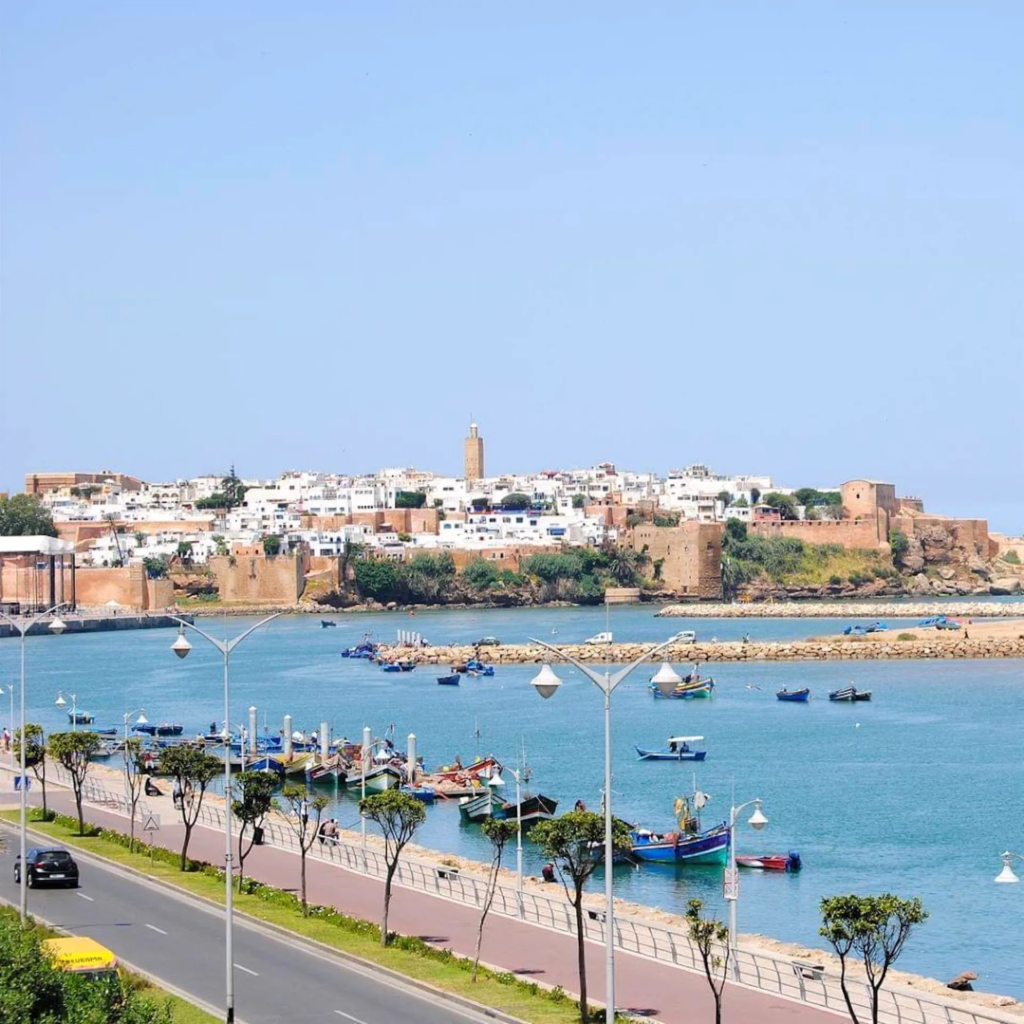
The highlight is the Kasbah of the Udayas, a whitewashed and blue-washed fortified village on a bluff where the Bou Regreg river meets the Atlantic. Walk through the 12th-century gate and the lanes, then sit in the Andalusian garden. Afterwards have mint tea and almond pastries at Café Maure, overlooking the river mouth and the surfers.
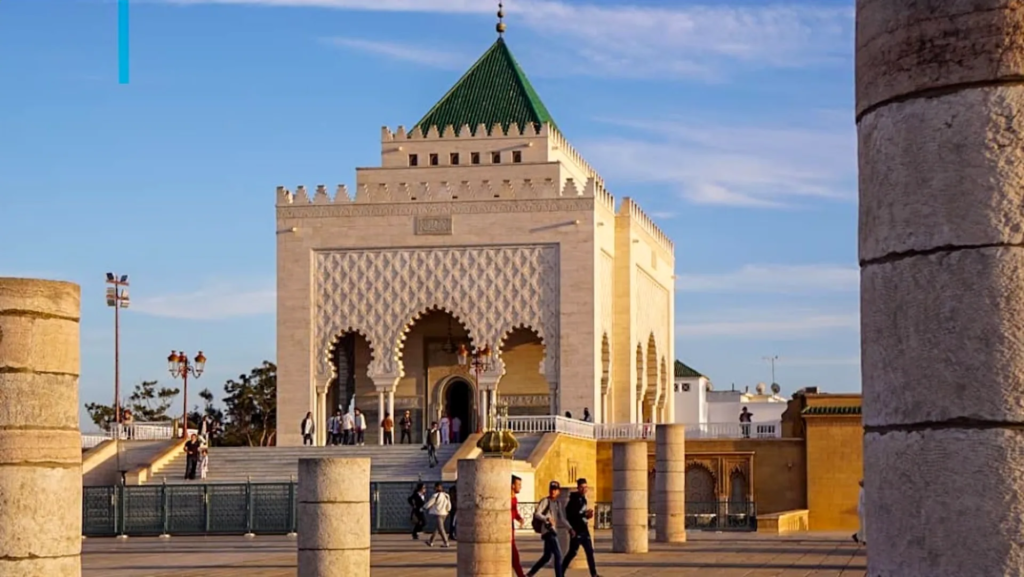
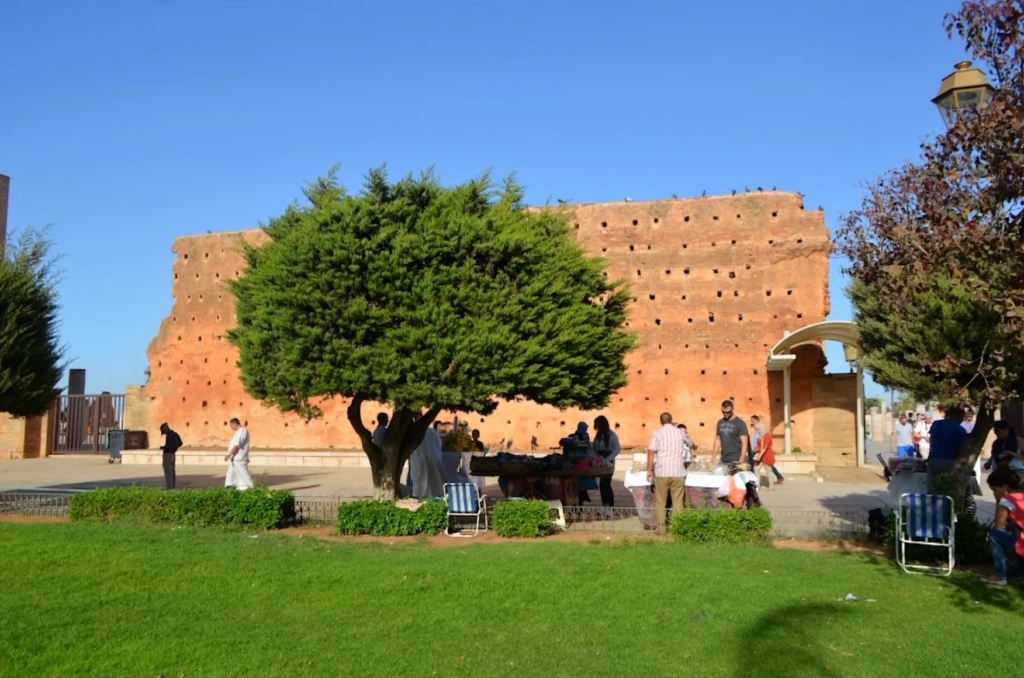
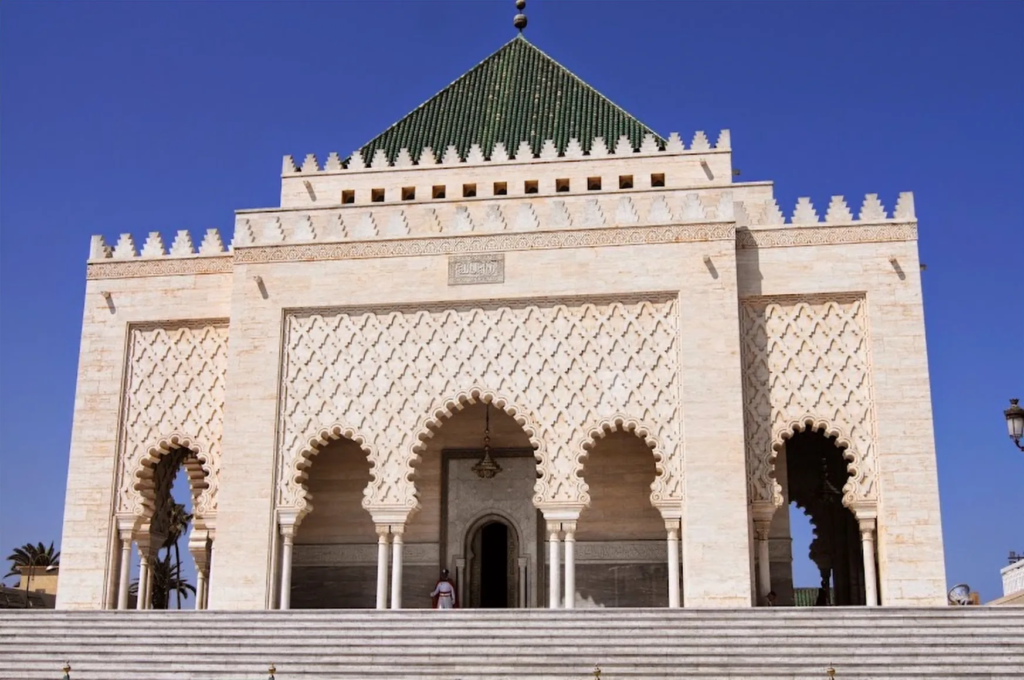
- Hassan Tower, the stump of a huge Almohad minaret left unfinished when Sultan Yacoub al-Mansour died in 1199. Opposite stands the Mausoleum of Mohammed V, with guards in ceremonial uniform at the gates.
- Chellah, a walled necropolis built over Roman Sala. It has storks nesting on the ruined minaret and overgrown gardens.
- The medina and Rue des Consuls for rugs and leather at prices noticeably lower than Marrakech, with far less haggling theatre.
- Mohammed VI Museum of Modern and Contemporary Art, if you want a break from monuments.
The honest downside: Rabat has fewer “wow” moments than Fes or Marrakech, and its nightlife is quiet. Its other strength is location. It’s on the Al Boraq high-speed line, so it’s an easy first or last stop if you fly into Casablanca or Tangier.
Ideal stay: 1–2 nights.
Meknes: the historic giant (with Volubilis next door)
Meknes is the most overlooked imperial city, and that’s half its charm. Sultan Moulay Ismail (who ruled from 1672 to 1727) wanted a capital to rival Versailles. He surrounded it with about 40 km of walls, monumental gates, granaries and stables said to hold thousands of horses. Much of it now sits in partial ruin, which gives the city a slightly melancholy grandeur.
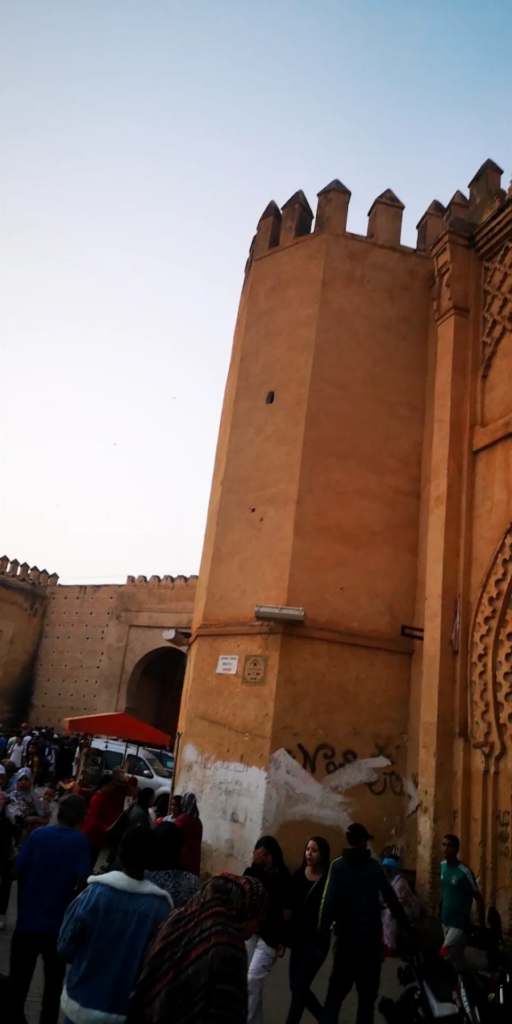
Start at Bab Mansour, often called the most beautiful gate in Morocco, with green and black zellige and marble columns taken from Volubilis. Opposite it, Place el-Hedim is a smaller, calmer Jemaa el-Fna, good for a mint tea and some people-watching. From there:
- Heri es-Souani, the vast granaries and stables, cool even in July thanks to their thick walls.
- Mausoleum of Moulay Ismail, one of the few working shrines non-Muslims may enter. It has been through long restoration works, so check it’s open before you plan around it.
- Dar Jamaï, a 19th-century palace that houses the national museum of music.
The real reason to come, though, is Volubilis, about 30 km north. It’s the best-preserved Roman site in Morocco, with mosaics still in place in the houses (look for the Labours of Hercules and Orpheus), plus a triumphal arch and a basilica set against wheat fields and olive groves. Entry is around 70 MAD. There is almost no shade, so go early or late from May to September. Pair it with the holy hill town of Moulay Idriss Zerhoun, five minutes away.
Ideal stay: a long day trip from Fes (60 km, under an hour by train or road), or one night if you want Volubilis at golden hour.
Imperial city matrix: quick comparison
| City | Main Vibe | Ideal Stay | Must-See Landmark | Tourist Crowds |
|---|---|---|---|---|
| Marrakech | Lively, theatrical, sun-soaked | 3 nights | Jemaa el-Fna & Koutoubia | Very high |
| Fes | Medieval, intense, authentic | 2–3 nights | Fes el-Bali & Chouara Tannery | Moderate to high |
| Rabat | Calm, coastal, orderly | 1–2 nights | Kasbah of the Udayas | Low |
| Meknes | Grand, faded, unhurried | Day trip or 1 night | Bab Mansour & Volubilis | Low (Volubilis moderate) |
Which imperial city should you choose?
Here’s the shortcut we give people on the phone:
- First time in Morocco, only one city: Marrakech. It’s easy to fly into, and the desert and mountains are within reach.
- You love history, architecture and crafts: Fes, with Meknes and Volubilis as a day trip.
- Travelling with young kids, or sensitive to hassle: Rabat is the gentlest introduction.
- You’ve done Marrakech before: Fes and Meknes will feel like a different country.
Timing matters too. July and August push Marrakech and Fes well past 38°C, while Rabat stays mild thanks to the ocean breeze. Spring and autumn are the sweet spot for all four. See our guide on the best time to visit Morocco for month-by-month detail.
How to visit all four imperial cities in one trip
Good news: three of the four sit on a single rail line, and the fourth is a straightforward connection. ONCF runs regular trains, and a typical route looks like this:
- Casablanca or Tangier → Rabat on the Al Boraq high-speed train (Tangier–Rabat is about 1 h 20 min). Spend 1–2 nights.
- Rabat → Meknes by classic intercity train, roughly 2 hours. Visit Meknes and Volubilis, or continue straight on.
- Meknes → Fes, around 40–50 minutes by train. Spend 2–3 nights.
- Fes → Marrakech is the long leg: about 7 hours by train, usually with a change in Casablanca or Rabat. Many travellers prefer to drive it via the Sahara instead, Fes to Merzouga then on to Marrakech over the High Atlas and the Tizi n’Tichka pass (2,260 m).
Approximate second-class fares: Meknes–Fes about 25–30 MAD, Rabat–Meknes about 70–90 MAD, Fes–Marrakech roughly 200–230 MAD (about €20). First class costs around 50% more and is worth it on the long Fes–Marrakech run. The Al Boraq extension towards Marrakech is under construction, so don’t plan around it yet. You can buy tickets at stations or through the official ONCF site, or we can arrange them for you via our train ticket service.
Trains are comfortable and cheap, but they do run late, and the Fes–Marrakech day eats a whole day. That’s why most of our travellers do the imperial circuit as a private road trip. Our 8-day imperial cities and Sahara tour links all four cities with a night in the Merzouga dunes, and the driver handles the parking, the medina drop-offs and the timing. Our 7-day Morocco itinerary shows how to fit a shorter version together.
Sample 8-day imperial route
- Days 1–2: Casablanca and Rabat
- Day 3: Meknes and Volubilis, overnight in Fes
- Day 4: Fes medina with a local guide
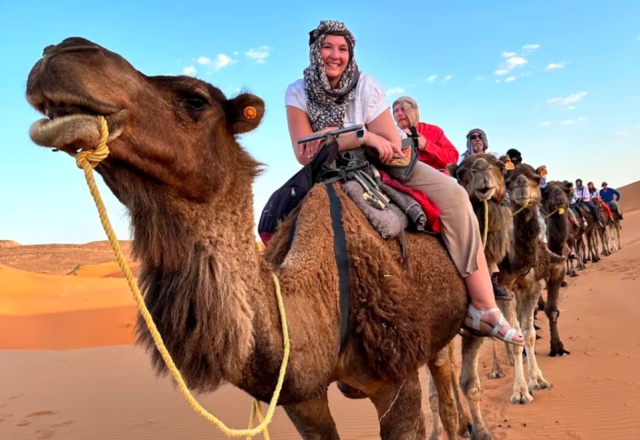
- Days 5–6: Middle Atlas, Ifrane and the cedar forest, then a camel ride and camp night in Merzouga
- Days 7–8: Todra Gorge, Dades Valley, Ait Ben Haddou and Marrakech
Frequently asked questions
What are the four imperial cities of Morocco?
Marrakech, Fes, Rabat and Meknes. Each served as Morocco’s capital under a different dynasty, and Rabat is the capital today.
Which imperial city is best for first-time visitors?
Is Fes or Marrakech better?
Fes feels older and more authentic, and its medina is larger and more traditional. Marrakech is livelier, warmer in winter and better connected. If you have time, see both. They complement each other well.
Can you visit Meknes and Volubilis as a day trip from Fes?
Yes. Meknes is about 60 km from Fes and Volubilis another 30 km beyond it. With a driver you can see Bab Mansour, the granaries, Volubilis and Moulay Idriss in one full day.
How many days do you need to see all four imperial cities?
At least 7 days, and 8–10 if you want to add the Sahara or travel at a comfortable pace. Rabat and Meknes need 1 day each, Fes 2–3 and Marrakech 2–3.
Is there a train between all four imperial cities?
Yes. ONCF connects Rabat, Meknes, Fes and Marrakech, although Fes–Marrakech takes around 7 hours and usually involves a change.
If you’d like help choosing, or want the imperial cities, the desert and the mountains in one smooth trip, tell us your dates and travel style. Our Marrakech-based team will put together a route that fits. Get in touch with us to start planning.