Moroccan Food Guide: Top Traditional Dishes You Must Try
The first thing most of our travellers ask after landing in Marrakech is not where the Koutoubia is. It is what they should eat for dinner. Fair enough. This Moroccan food guide is the list we give friends: the dishes worth hunting down, the ones you will only find on certain days, where we actually eat in Marrakech and Fes, and how to handle street food, vegetarian and gluten-free diets without spending the trip worrying.
In short: try at least one tagine (lamb with prunes or chicken with preserved lemon), couscous on a Friday, a pigeon or chicken pastilla, a bowl of harira, zaalouk with fresh bread, slow-roasted mechoui and Marrakech tanjia. Wash it all down with mint tea. Eat where locals queue, choose food cooked hot in front of you, and carry a few phrases if you avoid meat or gluten.
How Moroccans actually eat
Moroccan home cooking is slower and simpler than restaurant menus suggest. Lunch is the main meal, often eaten around 1–2 pm, and dinner can be as light as soup, bread and olives at 9 pm. Bread (khobz) is the cutlery: you tear a piece and use it to pinch food from the shared dish, right hand only.
Spicing is warm rather than hot: cumin, ginger, saffron, cinnamon and the house blend ras el hanout. If you want heat, ask for harissa. Regional specialities are summarised on the official Morocco tourism portal.
Must-try traditional Moroccan dishes
Tagine (and its many variations)
A tagine is both the cone-lidded clay pot and the stew cooked in it. The lid sends steam back down, so meat braises in its own juices over a low charcoal fire for two or three hours. The classics are worth ordering by name rather than just asking for “a tagine”:
- Chicken with preserved lemon and olives – sharp, salty, the one Moroccans cook for guests.
- Lamb or beef with prunes and almonds – sweet, often finished with toasted sesame.
- Kefta with eggs – spiced meatballs in tomato sauce with eggs cracked on top.
- Fish tagine – on the coast in Essaouira and Agadir, layered with potatoes, peppers and chermoula.
- Vegetable tagine – carrots, courgette, potato, peas. Good, but ask whether it was cooked with meat stock.
One honest note: tourist restaurants sometimes keep tagines warm all day. If the pot arrives within three minutes of ordering at lunchtime, it was not cooked for you. Small places with five or six pots lined up on a charcoal grill outside are usually the better bet. Expect roughly 50–90 MAD (€5–8) in a local café and 120–200 MAD in a riad restaurant.
Friday couscous
Couscous is a Friday dish. Families eat it after the midday prayer, and many local restaurants only serve it that day, so if you see it on a Tuesday menu, temper your expectations. The semolina is steamed two or three times over the broth, then piled into a mound with seven vegetables (squash, carrot, turnip, courgette, cabbage, chickpeas, sometimes pumpkin) and lamb or chicken.
Look out for couscous tfaya, topped with caramelised onions, raisins and cinnamon. We usually tell travellers to plan a Friday lunch around it; our drivers know the family-run places on the road.
Pastilla (bastilla)
Fes claims pastilla, and Fassis will tell you nowhere else does it properly. It is a flaky round pie of warqa pastry filled with shredded pigeon (or, more often now, chicken), eggs scrambled in onion and saffron sauce, and fried almonds, then dusted with icing sugar and cinnamon.
There is also a seafood pastilla with prawns, squid and vermicelli, no sugar, and a milk pastilla served as dessert. A good chicken pastilla to share costs around 80–150 MAD.
Harira
Harira is the tomato, lentil and chickpea soup thickened with flour and egg, sharpened with fresh coriander and celery. It is the dish that breaks the fast at sunset every night during Ramadan, traditionally with dates and chebakia, sesame cookies soaked in honey. Outside Ramadan you will find it in cheap cafés from early evening, often for 8–15 MAD a bowl.
Zaalouk
Zaalouk is a warm salad of smoked or boiled aubergine, cooked down with tomato, garlic, cumin and olive oil until it is almost a dip. It comes as part of the round of small “Moroccan salads” served before a meal, along with taktouka (peppers and tomato), carrots with cumin and beetroot. Mop it up with bread. It is naturally vegan, which makes it a lifeline for plant-based travellers.
Mechoui
Mechoui is a whole lamb slow-roasted in a clay pit oven until the skin crackles and the meat falls away in your fingers. In Marrakech it is sold by weight, served on paper with bread, cumin and salt. No sauce, and it needs none. A quarter kilo is plenty for one person; prices are roughly 40–70 MAD for that portion, depending on the cut and the stall.
Tanjia marrakchia
Tanjia is Marrakech’s bachelor dish, named after the tall clay urn it cooks in. Beef or lamb goes in with preserved lemon, garlic, cumin, saffron and smen (aged butter), and the urn is left for 6–8 hours in the hot ashes of the furnace that heats the neighbourhood hammam. The fire keeper, the fernatchi, minds the pots for a small tip. You will rarely find it outside Marrakech.
Msemen and baghrir
Breakfast in Morocco often means pancakes. Msemen is a square, layered flatbread fried on a griddle, sometimes stuffed with onions and spices. Baghrir, the “thousand-hole pancake”, is spongy semolina batter cooked on one side only, then drenched in melted butter and honey. Street vendors sell msemen for 2–5 MAD from early morning.
Snail soup (babbouche)
In the evening, look for the carts with steaming steel cauldrons. Snails are simmered in a broth with around a dozen herbs and spices, including liquorice, thyme, aniseed and wormwood, and served in a small bowl with a toothpick. A bowl costs around 5–10 MAD. Squeamish? Just drink the broth.
Rfissa
Rfissa is a comfort dish: shredded msemen or day-old flatbread soaked in a fenugreek-scented broth with chicken and lentils. Traditionally cooked for new mothers and family gatherings, you are more likely to meet it in a home than on a menu.
Mint tea culture
Mint tea, sometimes jokingly called “Berber whisky”, is not a drink, it is a ritual. Chinese gunpowder green tea is rinsed, brewed with a big bunch of fresh spearmint and a lot of sugar, then poured from a height to raise a foam. Accepting a glass in a shop does not oblige you to buy anything.
Ask for bla sukkar (without sugar) or chwiya sukkar (a little sugar) if you prefer. In winter, tea is often made with wormwood (chiba) instead, and in the south you may get louiza (lemon verbena). In a café, a glass or small pot runs 10–25 MAD.
Where to eat: the places we send travellers
Jemaa el-Fna food stalls, Marrakech
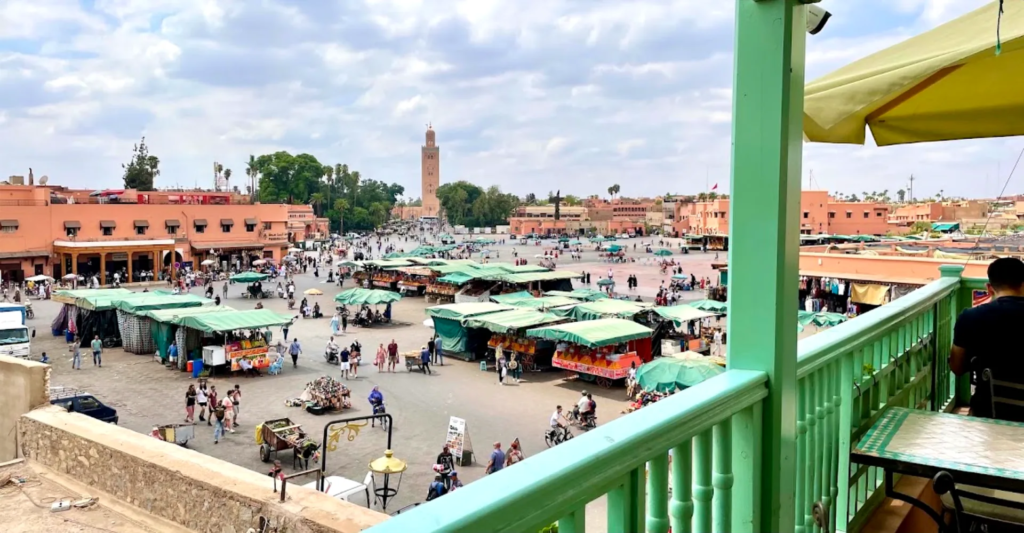
Around sunset the square at the heart of the UNESCO-listed Medina of Marrakesh turns into an open-air kitchen of numbered stalls. Grilled brochettes, fried fish, merguez, aubergine, sheep’s head and the snail soup carts all set up in rows. The atmosphere is wonderful; the hustle is real.
- Touts will pull you towards their stall. Walk the full rows first, then sit where Moroccan families are eating.
- Ask the price of everything before you sit, and check the bill: bread, olives and salads are sometimes charged even if you did not order them.
- Expect to spend roughly 60–120 MAD per person for a full meal.
Our Marrakech tours include an evening food walk that covers the square and the alleys behind it, which takes most of the guesswork out of the first night.
Mechoui Alley
On the northeast edge of Jemaa el-Fna, just behind the olive sellers, a short lane of tiny counters serves mechoui and tanjia from late morning until the meat runs out. You point at the cut, the cook weighs it, hacks it, and hands it over with bread and cumin salt. Go around noon, when the pit has just opened and the lamb is at its best.
Fes medina
In Fes, start at Bab Boujloud, where cheap grills and soup stalls line Talaa Kebira and Talaa Seghira. Order bissara, a thick split fava-bean soup with olive oil and cumin, for breakfast for around 10 MAD. Save a long lunch for a proper Fassi pastilla. Our Fes tours can combine a guided medina walk with a cooking class in a family riad.
What a day of eating costs (approximate, 2026)
- Street breakfast of msemen and tea: 10–20 MAD (€1–2)
- Local café lunch with tagine and salad: 60–100 MAD (€6–10)
- Riad or restaurant dinner: 150–350 MAD (€14–33)
- Fresh orange juice in Jemaa el-Fna: 10–15 MAD
For a fuller budget breakdown, see our guide to how expensive Morocco is.
Street food safety: how to eat well and stay well
Most stomach trouble we see comes from salads, tap water and food that has sat around, not from street grills. A few habits go a long way:
- Eat hot, eat busy. Food cooked in front of you at a stall with a steady queue turns over fast.
- Drink bottled water. Sidi Ali and Ain Saiss are everywhere for 5–7 MAD. Use it to brush your teeth in the first days if your stomach is sensitive.
- Be wary of raw salads and cut fruit at the cheapest stalls; peel-your-own fruit is safer.
- Orange juice squeezed in front of you is fine. Juice poured from a jug, or “topped up”, may be diluted with tap water.
- Pack basics: oral rehydration sachets. Pharmacies (green cross) are well stocked.
Summer heat is the other risk. In July and August, meat that has stood around is a worse bet, which is one reason we suggest spring and autumn in our best time to visit Morocco guide. For general health and entry advice, the UK Foreign Office travel advice for Morocco is kept up to date.
Vegetarian, vegan and gluten-free dining in Morocco
Vegetarian
Vegetarians eat well here, with some care. Moroccan salads, vegetable tagines and couscous, bissara, lentil dishes, omelettes, msemen and fresh bread are everywhere. The catch is that “vegetable” dishes are sometimes cooked in meat stock, and harira often contains a little lamb. Say bla lham (without meat) and, more usefully, ana nabati (I am vegetarian), and ask about the broth.
Vegan
Veganism is harder to explain. Smen and butter turn up in tagines, couscous and pastries, honey is in many sweets, and eggs in pastilla and harira. Zaalouk, taktouka, bissara, chickpea snacks and most bread are safe. Marrakech, Fes and Essaouira now have cafés with marked vegan options. Booking a riad that cooks for you lets you brief the kitchen once and relax; our notes on riads vs hotels in Morocco explain why.
Gluten-free
This is the toughest one, and we would rather be honest. Bread comes with every meal, couscous is wheat (barley couscous is not gluten-free either), harira is thickened with flour, and pastilla and msemen are pastry. Tagines and grills are usually fine, but cross-contamination is common. Carry a card in Arabic and French explaining your diet, and pack some snacks.
Our tip for special diets
Tell us when you book. On our private trips we contact riads and desert camps in advance, so the cook knows before you arrive rather than at the table. In the Sahara camps, with one supply run a day, that advance notice really matters.
A few manners at the table
Eat from the section of the shared dish in front of you and let the host distribute the meat. Alcohol is available in licensed hotels and some restaurants in the larger cities but not at street stalls or in most medina cafés. During Ramadan, many local cafés close during daylight; tourist restaurants stay open, and eating discreetly in public is the respectful choice.
Food shopping in the souks is also part of the experience. Spices, argan oil and dates are good buys; read our guide on how to bargain in Moroccan souks before you hand over cash for saffron, which is often cut with safflower at tourist stalls.
Frequently asked questions
What is the national dish of Morocco?
Couscous is generally considered the national dish, and in 2020 it was added to UNESCO’s intangible heritage list as a shared Maghreb tradition. Tagine is the dish visitors meet most often.
Is street food in Morocco safe to eat?
Usually, yes, if you choose busy stalls that cook food hot in front of you, drink bottled water and go easy on raw salads in the first few days.
Is Moroccan food spicy?
Not very. It is aromatic rather than hot, built on cumin, ginger, saffron and cinnamon. Ask for harissa if you want chilli.
Can vegetarians and vegans eat well in Morocco?
Vegetarians can, with care about meat stock. Vegans need more planning because of butter, smen, honey and eggs, but salads, zaalouk, bissara and vegetable couscous are good options.
Is it easy to eat gluten-free in Morocco?
It is difficult. Bread, couscous and pastry dominate, and cross-contamination is common. Grilled meats and tagines without bread are your safest choices; carry a translated diet card.
How much should I tip in Moroccan restaurants?
Around 10% in sit-down restaurants is appreciated. At street stalls, rounding up or leaving 5–10 MAD is normal.
Food is the easiest way into Morocco, and the best meals are often the ones you would never find alone. If you would like a trip built around markets, cooking classes and family tables, plan a tailor-made trip with our team, or contact us and tell us what you want to eat.