How to Get Around Morocco: Trains, Buses, Taxis, and Flights
The first time one of our travellers asked us about getting around Morocco, she had a spreadsheet with seven tabs. By the end of the call we had reduced it to three lines: train between the big cities, bus or shared taxi where the rails stop, and a driver for the mountains and the desert. That is still the honest summary of transport in Morocco, and this guide fills in the detail: what each option costs, how long it takes, and where it lets you down.
Quick answer: Use ONCF trains for Tangier, Rabat, Casablanca, Fes, Meknes and Marrakech (the Al Boraq high-speed line makes Tangier–Casablanca just over two hours). Use CTM or Supratours coaches for Essaouira, Agadir, Chefchaouen and the south. Take petit taxis inside cities, grand taxis between nearby towns, and a domestic flight only for long hops such as Casablanca–Dakhla. For the Atlas, the gorges and the Sahara, a private driver is usually the most efficient choice.
Trains: Al Boraq high-speed vs standard ONCF routes
Morocco’s national rail operator, ONCF, runs a clean, mostly punctual network across the north and centre of the country. Carriages are air-conditioned, there is a trolley selling coffee and biscuits, and stations in Casablanca, Rabat, Tangier and Marrakech have been rebuilt in the last decade. Trains do not go to Essaouira, Agadir, Chefchaouen, Ouarzazate or Merzouga, which shapes almost every itinerary.
Al Boraq, Africa’s first high-speed line
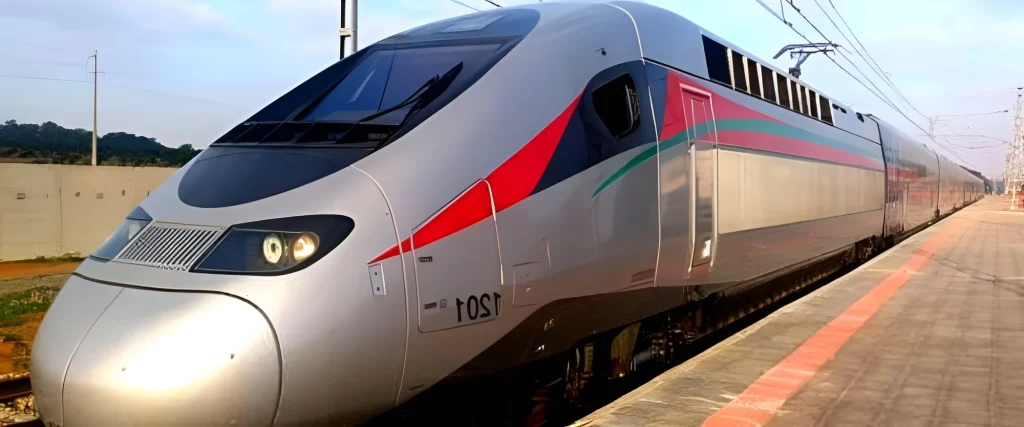
Al Boraq opened in 2018 and runs Tangier–Kenitra–Rabat–Casablanca at up to 320 km/h on the dedicated section. It is the fastest way to link the north with Casablanca, and the double-decker trains are genuinely comfortable. An extension south towards Marrakech is under construction, so for now Marrakech is reached by changing to a conventional train at Casablanca or Rabat.
Fares on Al Boraq are dynamic: book early and a second-class Tangier–Casablanca seat can be around 150–250 MAD (roughly €14–23 / US$15–25), rising closer to departure. First class costs more but gives you a reserved wide seat and is worth it on a Friday or before a holiday.
Standard lines (Al Atlas trains)
Conventional intercity trains connect Casablanca with Marrakech, and Rabat with Meknes, Fes and on to Oujda. Second class has no reserved seats on many services, which means standing in the corridor on busy days, especially around Eid and in August. We usually tell our travellers that first class, at roughly 40–60% more, is the cheapest upgrade they will make all trip.
There is also an overnight train between Marrakech and Tangier with couchette and sleeper cabins. It is a fun experience and saves a hotel night, though sleep is not guaranteed.
| Route | Train type | Approx. journey time | Approx. 2nd class fare |
|---|---|---|---|
| Tangier – Rabat | Al Boraq | 1 h 20 min | 110–200 MAD |
| Tangier – Casablanca | Al Boraq | 2 h 10 min | 150–250 MAD |
| Rabat – Casablanca | Al Boraq / standard | 50 min – 1 h | 40–90 MAD |
| Casablanca – Marrakech | Standard | 2 h 40 min | 110–160 MAD |
| Casablanca – Fes | Standard | 3 h 30 min – 4 h | 120–170 MAD |
| Fes – Meknes | Standard | 40 min | 25–35 MAD |
| Fes – Tangier | Standard + Al Boraq (change at Kenitra) | 3 h – 3 h 30 min | 180–280 MAD |
| Marrakech – Fes | Standard | 6 h 30 min – 7 h | 220–270 MAD |
| Marrakech – Tangier | Standard + Al Boraq, or night train | 5 h 30 min (day) / 10–11 h (night) | 250–400 MAD |
Times and prices are approximate and change with timetables and demand. Always check the latest schedule on the official ONCF booking site.
Train tips from our team
- Book Al Boraq and first-class seats a few days ahead; the ONCF app accepts foreign cards most of the time, but not always.
- Keep your ticket until you leave the station; inspectors check on board and at the exit gates.
- Marrakech station sits outside the medina; budget 30–50 MAD for a petit taxi to Jemaa el-Fna.
- If you would rather not wrestle with the app, we can book your Moroccan train tickets for you.
Long-distance buses: CTM and Supratours
Where the railway ends, two coach companies take over. CTM is the national bus company with the widest network, and Supratours is ONCF’s coach arm, timed to connect with trains. Both are a big step up from the private local buses that leave from city gares routières, which are cheaper but slower, hotter and less predictable about departure times.
Typical routes and what to expect
- Marrakech – Essaouira: around 3 hours, roughly 90–110 MAD. Supratours leaves from beside Marrakech train station; CTM from its own depot near Bab Doukkala.
- Marrakech – Agadir: about 3 h 30 min on the motorway, roughly 110–140 MAD.
- Fes – Chefchaouen: around 4 hours over winding roads, roughly 80–100 MAD. Seats sell out in spring and summer.
- Marrakech – Merzouga: an overnight run of 12 hours or more via Ouarzazate and Tinghir, roughly 200–250 MAD. Long, but it works on a tight budget.
Booking and comfort
Both companies sell tickets online and at their offices; see CTM and Supratours. Book a day or two ahead on popular routes, and several days ahead around public holidays. Expect to pay a small luggage fee, usually 5–10 MAD per bag, and keep the sticker receipt; you need it to collect your bag.
Coaches are air-conditioned and seats are reserved, but toilets on board are rare and the air-con is set to arctic. Bring a layer. Rest stops happen every two to three hours at roadside cafés selling grilled meat, mint tea and msemen. CTM’s premium coaches have wider seats and are worth the extra few dirhams on long trips. Our team can also reserve CTM and Supratours bus tickets if you want seats confirmed before you land.
Local taxis: petit taxis vs grand taxis
Taxis are part of daily life in Morocco and come in two kinds. Mixing them up is the most common mistake we see on day one.
Petit taxis: inside the city
Petit taxis are small cars, licensed to carry up to three passengers and only within city limits. Each city paints them in its own colour, which makes them easy to spot:
- Marrakech: beige
- Casablanca: red
- Fes: red
- Rabat: blue
- Tangier: turquoise-blue with a yellow stripe
- Agadir: orange
- Essaouira: light blue
By law they should use the meter. In Casablanca and Rabat drivers mostly do; in Marrakech it can take a polite but firm “the meter, please” (“compteur, s’il vous plaît”), and some drivers will simply refuse and drive off. Short rides in town usually cost 10–30 MAD. Expect a 50% surcharge at night, generally from around 8–9 pm. Drivers often pick up other passengers going the same way, which is normal and does not change your fare.
Grand taxis: shared routes between towns
Grand taxis are larger vehicles, historically old Mercedes saloons and now mostly Dacia or similar people-carriers, that run fixed routes between towns and to villages without bus service. They leave from dedicated ranks when full, typically with six passengers, and each pays a fixed per-seat fare. Fes to Meknes or Marrakech to Asni in the Atlas foothills are classic examples.
Two tips. First, you can buy extra seats, or the whole car, if you want more space or want to leave immediately. Second, the front seat is shared by two passengers, so it is less comfortable than it looks. Grand taxis also do private hires, such as airport runs or a day trip, at a price you agree before setting off.
Domestic flights
Morocco is bigger than most people expect; Tangier to Dakhla is further than London to Rome. For the far south, flying is the only sensible option. Royal Air Maroc runs the main domestic network, mostly through its Casablanca hub, while low-cost carriers such as Air Arabia and Ryanair have added some point-to-point routes. Schedules change each season, so check before you plan around a particular flight.
- Casablanca – Dakhla: about 2 hours, against 20+ hours by road. The obvious choice for kitesurfing trips to the Dakhla lagoon.
- Marrakech – Fes: about 1 hour in the air, versus nearly 7 hours by train. Useful if you are short on time, though airport transfers and check-in eat into the saving.
- Casablanca – Ouarzazate, Errachidia, Laayoune or Oujda: handy for reaching the edges of the country.
One-way domestic fares vary widely, from around 500 MAD on a promotion to 1,500 MAD or more at short notice. Watch baggage allowances on low-cost tickets. You can also ask us to arrange domestic flights in Morocco as part of a wider itinerary.
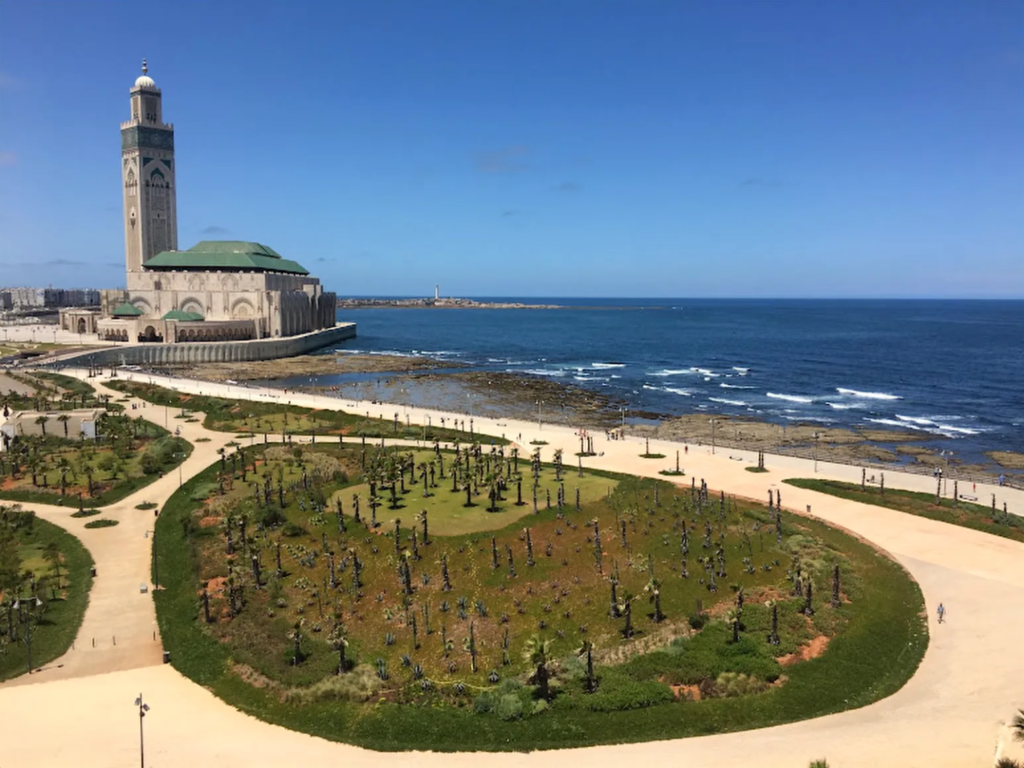
Airport transfers
Moroccan airports are run by ONDA; the ONDA website lists flight information and facilities. Getting into town is straightforward if you know the options:
- Casablanca Mohammed V: a shuttle train runs to Casa Voyageurs and Casa Port in about 35–45 minutes (around 45–50 MAD). Taxis into the city cost roughly 300–350 MAD and take 40–60 minutes depending on traffic.
- Marrakech Menara: only 6 km from the medina. Airport bus 19 runs to Jemaa el-Fna for around 30 MAD; taxis ask roughly 100–150 MAD, more at night.
- Fes Saïss: about 15 km out. Taxis charge a fixed fare of roughly 120–150 MAD to the city, but cars cannot enter the medina, so arrange for your riad to meet you at the nearest gate.
- Tangier Ibn Battouta and Rabat-Salé: taxis are the norm, roughly 150–250 MAD into the centre.
For late-night arrivals or families with luggage, a pre-booked transfer removes the haggling and the hunt for your riad down a dark derb.
When a private driver makes more sense
Public transport works well on the Tangier–Casablanca–Marrakech–Fes axis. It struggles as soon as you head for the High Atlas, the Dades and Todra gorges, the kasbahs around Ait Benhaddou, or the dunes at Merzouga. Buses run once or twice a day, grand taxis need several changes, and you see the scenery through a window at speeds you cannot control.
Marrakech to Merzouga is about 560 km and 9–10 hours by road over the Tizi n’Tichka pass at 2,260 m. Fes to Merzouga is about 470 km and 7–8 hours. On a bus those are full, fixed days. With a driver they become two-day journeys with stops at Ait Benhaddou, a lunch of tagine in a Dades village and a sunset walk in the gorges. Last spring a couple who had planned it all by bus switched halfway, after a CTM cancellation left them stuck in Ouarzazate for a day; they wished they had booked a driver from the start.
A driver also makes sense for families, groups of three or more (where the cost per head falls quickly), and anyone who wants to stop for photos. You can hire a car with a driver in Morocco for specific days, or let us build the whole route into one of our private Morocco tours. Popular routes include the 3-day Marrakech to Fes desert tour, which covers the hardest stretch of the country for public transport in one go. If you would rather drive yourself, read our guide to driving in Morocco first.
A simple rule of thumb
Cities on the rail line: take the train. Coast and Chefchaouen: take the coach. Mountains and desert: take a driver. Far south: fly. For how this fits into a real week, see our 7-day Morocco itinerary, and for budgeting, our guide to how expensive Morocco is.
Frequently asked questions
What is the best way of getting around Morocco?
For the main cities, the train is fastest and most comfortable. For Essaouira, Agadir and Chefchaouen, use CTM or Supratours coaches. For the Atlas Mountains and the Sahara, a private driver or organised tour saves a lot of time.
Does the high-speed train go to Marrakech?
Not yet. Al Boraq runs Tangier–Kenitra–Rabat–Casablanca, and the extension towards Marrakech is under construction. For now you change to a standard train, and Casablanca–Marrakech takes about 2 h 40 min.
Is there a train from Marrakech to Merzouga or Chefchaouen?
No. The rail network does not reach the desert, Chefchaouen, Essaouira or Agadir. Use a coach, a grand taxi or a private driver for these places.
Are taxis in Morocco safe and do they use meters?
Taxis are generally safe. Petit taxis should use the meter inside cities; if a driver refuses, agree the fare before getting in or wait for the next one. Grand taxis charge fixed per-seat fares on set routes.
Is it cheaper to take the bus or the train in Morocco?
On most routes coaches are slightly cheaper than second-class trains, but the train is usually faster and more comfortable where both run. Local private buses are the cheapest of all but are slow and less reliable.
Do I need to book Moroccan trains and buses in advance?
For Al Boraq, first class, popular CTM routes and any travel around Eid or in August, yes, book a few days ahead. Standard second-class trains can usually be bought at the station on the day.
Transport in Morocco is easier than it looks once you match the right option to each leg of the trip. If you would like help stitching trains, buses and a driver into one smooth route, get in touch with our Marrakech team and we will plan it with you.
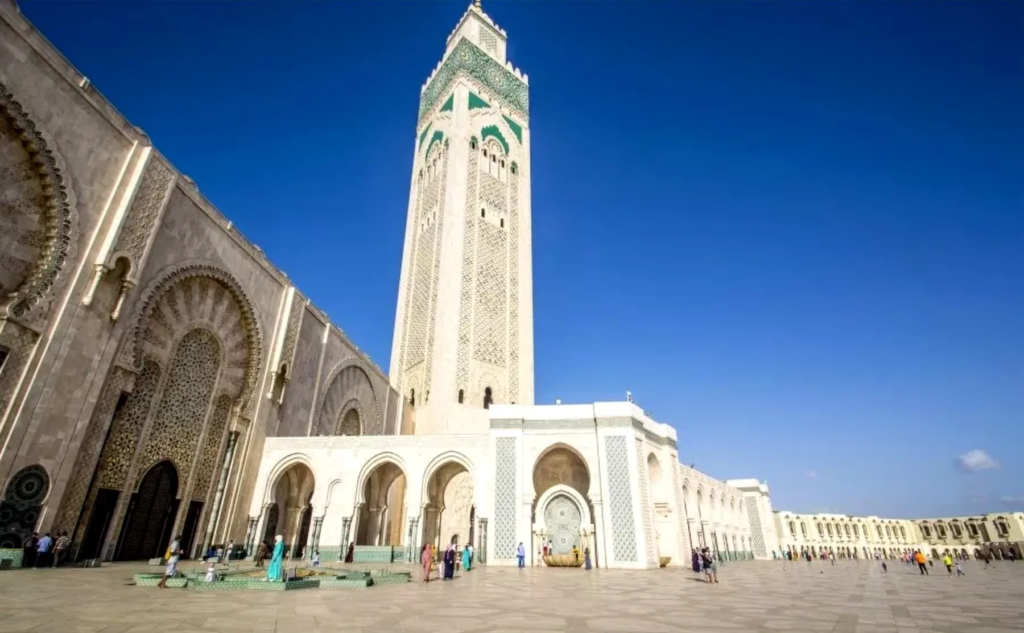
Getting from the airport to the city
- Casablanca Mohammed V – direct train to the city centre (about 40 minutes), or a grand taxi.
- Marrakech Menara – about 15 minutes to the medina by taxi or the airport bus.
- Fes Saïs – about 25 minutes by taxi; agree the fare before you leave.
- Tangier Ibn Battouta – about 25 minutes to the city by taxi.
Prefer to be met at arrivals? Book a private transfer with a driver. For flight options, see flights to Morocco.
Sample journeys
| Journey | Best option | Approx. time |
|---|---|---|
| Casablanca – Marrakech | Train | 2 h 40 |
| Tangier – Casablanca | Al Boraq train | 2 h 10 |
| Fes – Chefchaouen | CTM bus or private driver | 4 h |
| Marrakech – Essaouira | Supratours bus | 3 h |
| Marrakech – Merzouga | Desert tour or night bus | 9–13 h |